
Tear Down This Wall
Part 12: I Come Undone

The day after Margaret Thatcher won the election in the UK, Ronald Reagan visited Berlin to join in the 750th anniversary celebrations1. His speech, given on 12 June 1987 behind a massive sheet of plexiglass, in front of the Wall at Brandenburg Gate, went down in history for its famous quote:
Mr. Gorbachev, open this gate!
Mr. Gorbachev: Tear down this Wall!2
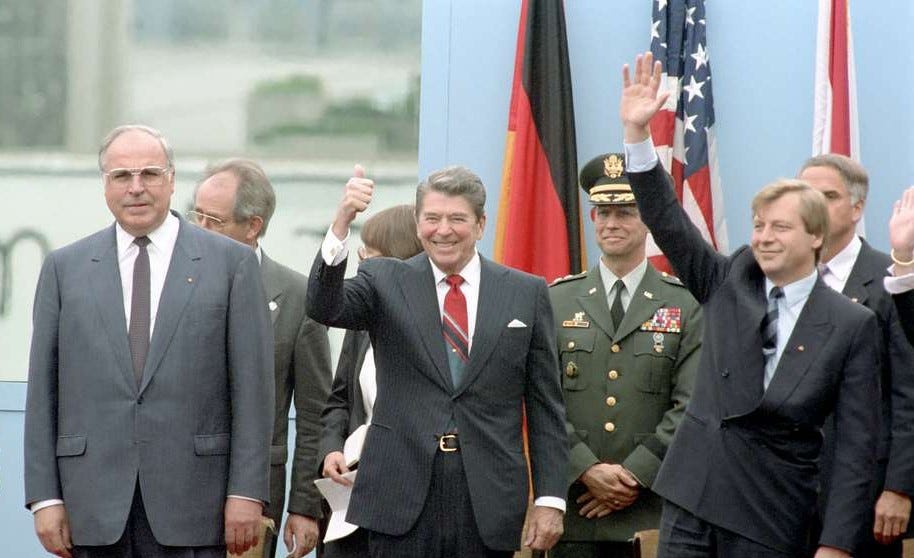
Reagan was one in a line of Allied heads of state that visited Berlin during the celebrations. Queen Elizabeth had held a birthday parade and had tea with West German President Richard von Weiszäcker on May 26 and 27. France’s President Francois Mitterand had also visited. But unlike the Queen and the French President, Reagan was not welcomed with open arms by all the people of West Berlin. Quite the opposite.
On 12 June 1987 between 24,000 and 50,000 people gathered to protest against Reagan’s policies, particularly regarding nuclear arms. The area was widely cordoned off, so that the demonstration would not affect the visit which infuriated people even more. 10,000 police, including many brought in from West Germany, were given the job of preventing violence, like had been experienced during Reagan’s visit five years previously.
Rather than preventing it, the heavy policing in full riot gear aggravated the protestors more. The autonomous ‘black bloc’ were out looking for trouble, wearing balaclavas. Riots broke out, shop windows were broken and looted. Bottles and firecrackers were thrown at the police, cars set alight.
The police were ready and willing to crack down, with clubs, water cannons, and teargas. I can’t describe what happened first hand, as I didn’t attend the demo. But my husband of today remembers it well:
“After the demo we couldn’t get back to Kreuzberg because it was cordoned off and the U-Bahn was no longer running. We didn’t take part in the riot, but the police chased hundreds of us through Schöneberg anyway. We tried to take refuge in Café M in Goltzstraße, but the police stormed in, smashing up everything in their path. They beat on the metal tables with their batons, the noise was incredible. They beat us back out of the door of the café, and then we ran and ran, trying to get away from them. It was almost impossible to escape through the narrow streets. Winterfeldplatz was full of police truck, we were surrounded…”
The New York Times3 questioned whether the demonstration was even necessary, quoting the taz newspaper that said “Nobody really knows why one should demonstrate against Ronald Reagan”. They described West Berliners as following a “Pavlovian Reflex” in protesting against Reagan. Having met with Gorbachev in Reykjavik in Autumn 1986 and talks between the two leaders looking to produce nuclear disarmament results (which they did), it was publicly debated what the protest would achieve.
Afterwards, the main debate was about the heavy-handed policing which was strongly criticised by the Green Party (Alternative Liste), Social-Democrats (SPD) and Liberals (FDP). Particularly the cordoning off of a large part of Kreuzberg and “kettling” (trapping demonstrators by surrounding them) was seen as disproportionate, and the latter practice was held to be illegal4.
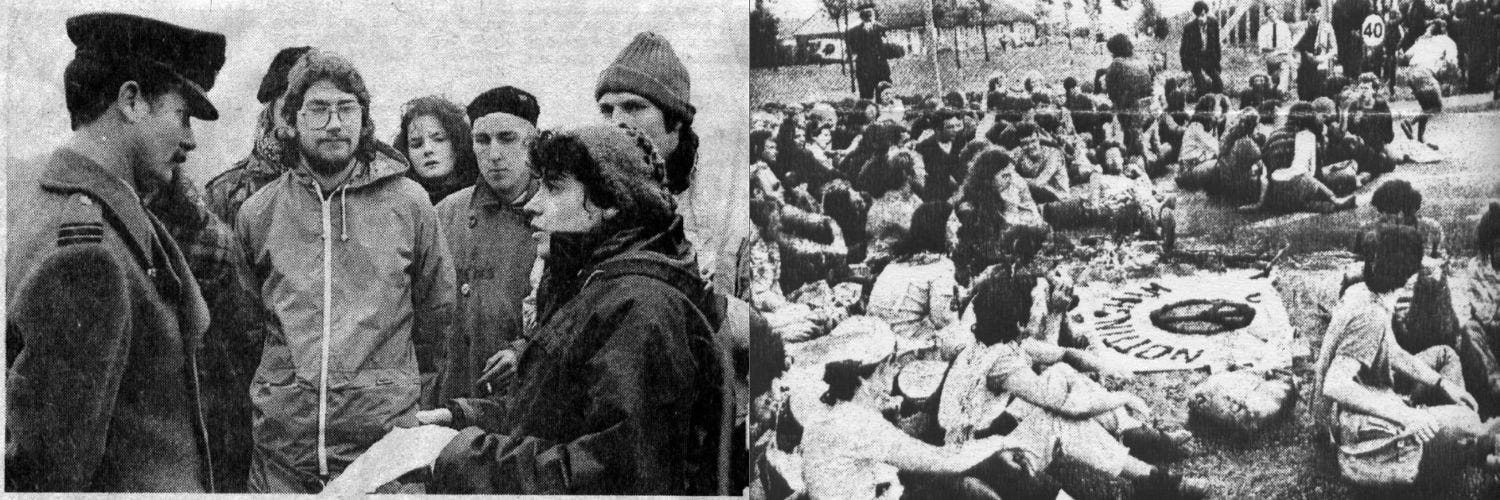
All this went by me in a kind of blur. Despite my years as an activist for Campaign for Nuclear Disarmament (CND) in the UK, blockading nuclear bases at Greenham Common and Molesworth to try to stop the deployment of Cruise Missiles in 1983, I had lost the desire and the inclination to protest. I felt like we had lost the battle, not knowing that the war against nuclear weapons would go on for most of my working life and become my career.
Reagan had visited London in June 1984 and I was caught in the middle of a row between CND and the Non-Violent Direct Action movement as to whether we should take direct action, given the trigger-happy security and the risk of violence. Similarly, the Reagan demo in 1987 looked likely to end up in violence, so I kept my distance again.
In hindsight, and having read Gorbachev’s “Memoirs”, I know now that the massive wave of protests in Western Europe against nuclear armament convinced him of the sincere desire of people in the West to live in peace without nuclear weapons. He had been impressed enough to try and reach an agreement to abolish them altogether5.
But I was too busy anyway being a groupie, going from pub to pub, devotedly listening to Bryan’s every song. I didn’t even notice that Prisoner No. 7, Rudolf Hess, killed himself in his Spandauer prison cell. At 93 years old, he still amazingly had the strength to hang himself with an electric cable on 17 August 19876. While I wasn’t looking, a man called Michael Ryan shot 16 people in Hungerford, UK7, the worst mass shooting in the UK till Dunblane in 1996. I also missed Michael Jackson releasing the most successful album of all time, “Bad”, although I danced to it for years afterwards, still not sure if Michael Jackson was bad, or not. Perhaps the newly released Biopic “Michael” will put this question to bed. Probably not.
Worst of all, the signing of the INF Treaty on 8 Dec 19878 completely passed me by. In years to come, I was to frequently lecture about this landmark treaty that removed all intermediate nuclear forces from Europe, and how Donald Trump later destroyed it. While our many of years of solid work for nuclear disarmament was reaping dividends in 1987, I was in a boozy fug, digging a hole for myself that took years to climb back out of.
I persuaded myself I was doing deep research for my novel about the real West Berlin, seen from inside Eck-Kneipen (corner pubs), from the bottom of a schnaps glass. Bryan took me to places in Schöneberg where genuine West Berliners — a rare breed — spent their nights, slurring declarations of love and abuse at each other, dancing by holding each other upright and often sinking to the floor in peals of laughter. He took me to a Yugoslavian club in Hauptstraße where music was played to the tempo of 7/12, and they all loved the same music, before people were divided down into their ethnic groups and armed to the teeth. I watched men agree to go outside to fight each other, then return to their barstools with bloody noses, and buy each other a drink, argument settled. And all the while I too was drinking more than I should have done.
So this momentous year of 1987 ended: being woken up from a semi-coma by someone who had entered through the door to my apartment, that I had drunkenly forgotten to close, to be told by them that my floor was several inches deep in water. I had flooded my kitchen, and now I needed, once again, to look for a new place to live.
Next up: Talkin bout a revolution
Listen to my playlist “Back in the Day in 1987”
Back in the Day in Berlin is a a personal perspective series documenting 40 years of living in Berlin. If you want to know what happened in previous episodes, go back to the first one: Life in Colour.
In his “Proclamation 5665”, Reagan called on US citizens to celebrate and honour Berlin on this occasion.
“The history and character of Berlin and its people give powerful testimony about human nature and its capabilities. After three-quarters of a millennium and many shocks and reversals through the ages, Berlin is yet a young city -- young with all the capacity of the human spirit to renew itself, to strive and to seek, to build anew and create, and, most of all, to hope. Time and again, Berlin has overcome desolation and isolation with will, energy, and courage. Even now, its spirit towers over the wall that presently divides the city.” Ronald Reagan, 8 Jun 1987
[Reagan R: Proclamation 5665, 8 Jun 1987]
The speech itself was hotly debated by US political circles. The speechwriter, Peter Robinson, describes the difficulties he had in drafting it in this article: [Robinson P: Tear Down This Wall, Prologue Magazine, National Archives, Summer 2007]
The numbers of attendees were, as always, very variable. NYT took the police estimate of 24,000. The demo organisers said there were 50,000. The figure is likely somewhere in between. [Schmemann S: 24,000 demonstrate in Berlin against Reagan’s visit today, New York Times (paywall), 12 June 1987]
The Alternative Liste (AL) said the West Berlin Senate had contravened the Helsinki final act, signed in August 1975 to reduce tensions between the Soviet Union and the West. The FDP said that parts of Berlin were “held hostage” by the police action. SPD’s Walter Momper said Mayor Eberhard Diepgen should send Interior Minister Kewenig “in die Wüste” (meaning: to boot him out). [Spiegel: Ordentlich scheppern, 21 June 1987]
See Through the Barricades for more on what happened in Reykjavik between Gorbachev and Reagan.
Hotly debated for many years was the question of whether Hess really killed himself. [Robinson M: Did Rudolf Hess really commit suicide? Berlin Experiences, 13 Nov 2025]