
Life in colour
Part 1: My first impressions of West Berlin

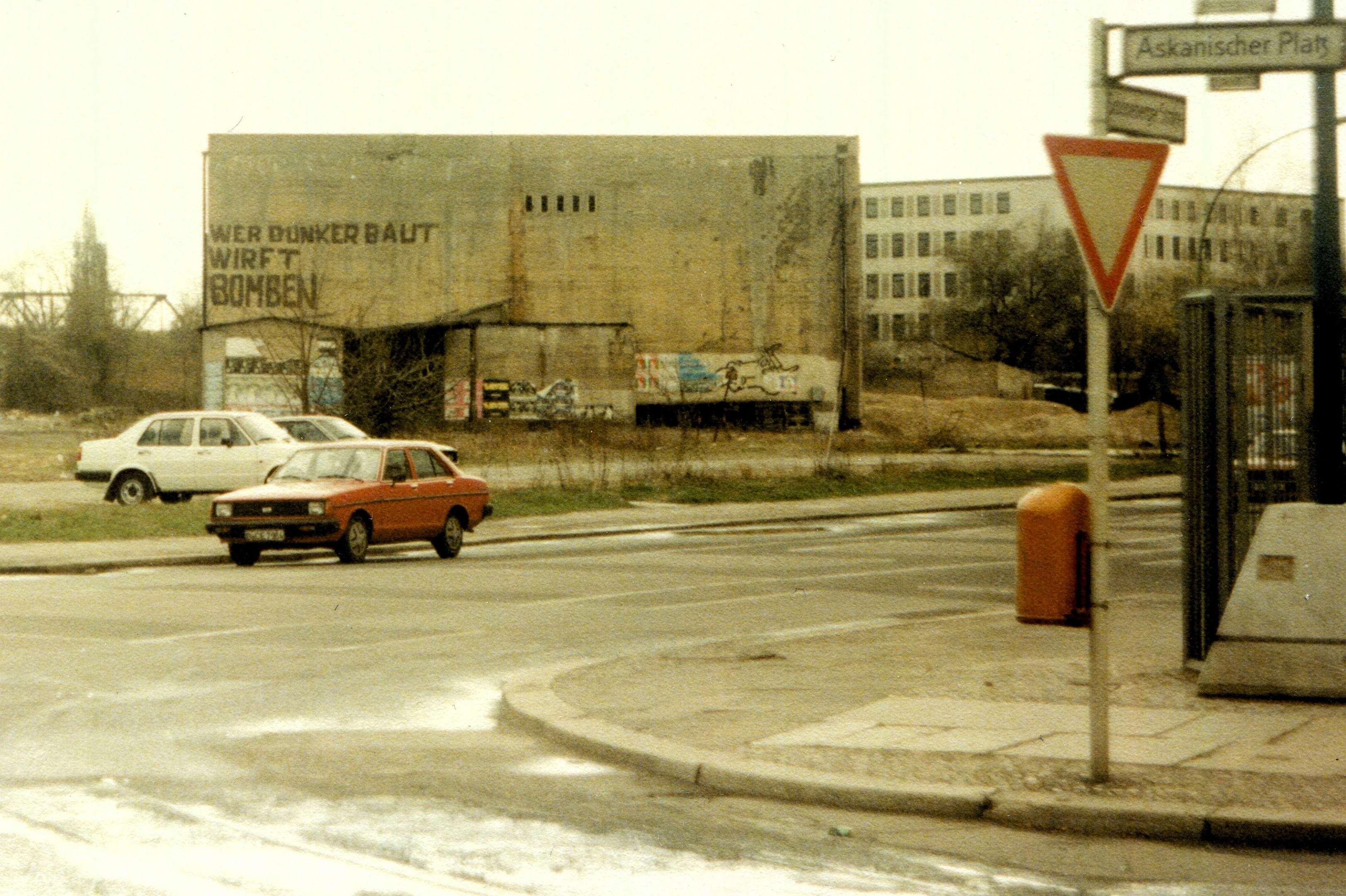
I moved to Berlin — or more accurately West Berlin — in May 1985, just over 40 years ago. The date sticks in my mind because of the fallout of my leaving the day before my ex-partner’s birthday. He saw way more significance in that, than I had intended.
In a way he was right: I was fleeing my old life in Birmingham and looking for adventure, without him. I had tied myself down too young, working too hard and being too committed. I felt like I had — after wild teenage years — sobered up more than I should have done, and was missing out, in an unforgiving country that I didn’t much like. I had devoted my young twenties to political activism and yet still the British people chose to vote a second time for Margaret Thatcher. I could not forgive them for that.
The Falklands War1 and the deployment of Cruise missiles in the UK2 had taken away my naivety and left me wondering: what had it all been for? All that sitting on asphalt in front of nuclear bases and singing about being old and strong. I felt young and weak when a policeman dragged me away by the hair and a horse trotted over my head. Why bother, when the government was hell bent on Cold Warring and fighting over tiny islands full of sheep, sacrificing young men who had only joined up to escape mass unemployment?
So to me, Berlin felt like suddenly entering a colour film after stepping out of a black and white one. My ex called it “The Playground of the Western World”. He disparaged it as fake. Once again, he was right in a way because money was poured into West Berlin to keep it vibrant, alive and kicking against the East. It’s whole existence was dressed up artificially to make the East German population look on with jealousy, and wish that they too could have Levi jeans and Dr Oetker baking powder to make their sponges rise. If you lived in West Berlin it was all about having fun. A big party that only capitalists were invited to.
Actually, the reality under that shiny surface was quite different. Just ask Christiane F3. But I’m getting ahead of myself here. I should start at the beginning:
I visited West Berlin in April 1985 as a kind of challenge. My friend — no full disclosure, I’ll just call him G — was doing a voluntary service with an NGO called “Aktion Sühnezeichen Friedensdienste” (Action Reconciliation - Services for Peace)4 in Birmingham. He claimed that West Berlin was the best place in the world. Well, he would say that, having been born there. I would say that Scotland (maybe not specifically Dundee) was the best place in the world, as I was born there. So we disagreed.
At the same time, I was none too enamoured of Germans who,up until now, I’d only met on holiday — I could write a whole post on just that, but I won’t elaborate. On the other hand, I did take quite a fancy to young G, so I took him up on the challenge to visit him in West Berlin after his service was over, and see this amazing city (or half a city) for myself.
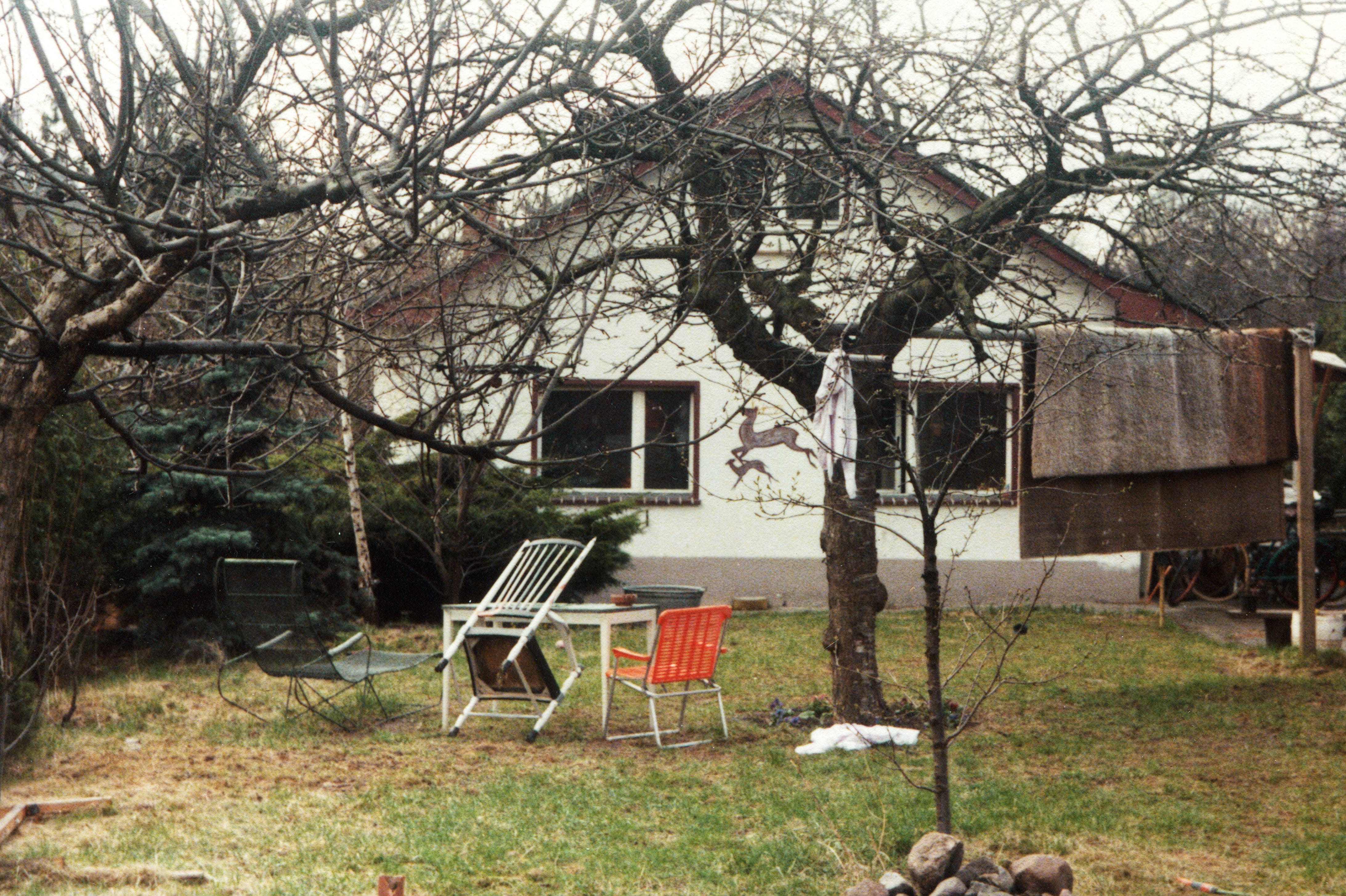
G was living in a kind of commune on the outskirts of West Berlin (officially belonging to Spandau5) in the British sector6. The little house was in a large garden near the Havel lake and opposite the British Commander’s mansion. The commune grew large cannabis plants in the garden, went swimming in the lake (naked) most days, and smoked immense amounts of weed. Everyone wandered around the house and garden naked, which invaded my English sensibilities, and I was never quite sure where to look in case my eyes bumped into some genitals. But they were all super friendly and spoke excellent English. Somehow the Germans, at least the young ones, looked so much better than the English — glowing with health, tanned and fit. Probably all that muesli and fresh fruit. All the freshest, best produce was flown into West Berlin to keep people healthy and happy, so they would stay. They were nothing like the pasty Brummies that had all grown up on Mother’s pride7 and cheap cuts of meat. I was a vegetarian at the time, because I got sick of neck of lamb stew, and I had no money.
There were also lots of young men in Berlin, many escaping military service8, as well as Allied soldiers. There were young women too — servicing the occupying soldiers as secretaries, translators or serving them drinks in bars and pubs.
G had borrowed a friend’s car and took me on a sightseeing tour of the city. He took me to Kreuzberg which he said was an area many avoided as being too dangerous, but he liked it there. (I’ll tell you more about Kreuzberg later in the part when I lived there but only to say: not dangerous in the slightest, just very diverse).
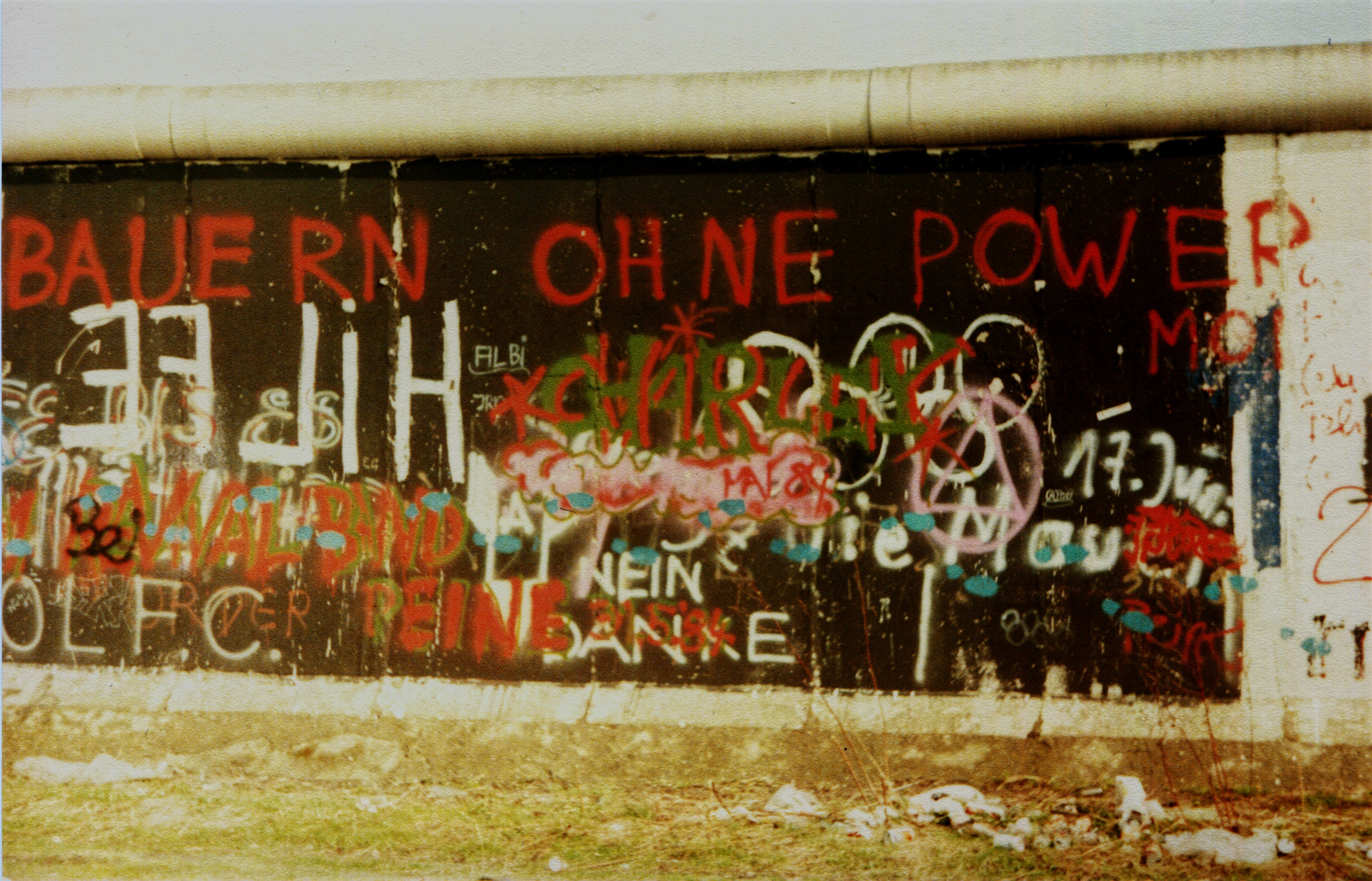
Being a graffiti lover and painter of murals myself, I spotted a brightly coloured wall and shouted at G to stop the car, so I could take some photos. We got out, G smiling to himself while we approached the wall. It was higher than us and had concrete piping along the top.
“What’s this wall doing here?” I asked, looking around me vacantly at the crowded street, not noticing the tramlines disappearing under the wall. After several moments of stupidity it hit me: this was The Wall. The road to another part of the city was blocked by it with a finality that was undeniable.
“Why is it so small?” I asked G. “You could easily get over it with a ladder.”
At this point you may be thinking — how dumb is she, exactly? But I wasn’t really any dumber than most 25 year-olds from another part of Europe, or the world, for that matter. We might have caught a documentary on the stand-off in the Berlin Crisis of 1961 at Checkpoint Charlie9, or knew about Kennedy’s famous speech “Ich bin ein Berliner”10. (By the way, that meant he was a kind of jam-filled doughnut. If you came from the city you would just say “Ich bin Berliner”. But I learnt that later too).
The history lesson of that day was understanding What is The Wall? And to learn that G took me to the corner of Luckauer- and Waldermarstraße, where a wooden viewing platform stood. The view from the top was astounding. “The Wall” is not simply a wall, but a system of twelve components, making up a scary landscape. From West to East they were:
the official borderline (invisible) where West and East Berlin end and begin.
a narrow strip on the West side of the wall which belongs to the German Democratic Republic (GDR). If you touched the wall, you were actually standing on GDR territory and Western forces had no authority to protect you.
The front wall or “fence”, 3.20 metres high, made up of steel reinforced concrete slabs 1.20 metre wide and tooped with concrete piping to make climbing over difficult.
Trenches or tank barriers to prevent vehicles from driving up to the wall.
“K6” control slip, a six-metre stretch of sand, raked over, so that footprints could be easily detected. This was also called the “death strip” as it was an exposed stretch that escapees would rush across and often get shot at by the border guards.
The patrol strip made of asphalt where border guards could patrol, often with dogs.
Watchtowers on the protective strip where border guards watched over the death strip and could shoot anyone trying to escape.
“K2”, another control slip, two metres wide.
An electrified fence that set off an alarm in the control centre when touched, called the “Border signal fence”.
The back wall or “fence”, the same construction as the front one (only not as prettily painted, for obvious reasons).
Sometimes there was additional fencing or another control strip.
The “No-Go-Zone” of various widths.11
Beyond this were the border controls, and more watchtowers. Where the river formed the border, there were steel underwater mats spiked with nails. In the sewers were barbed wire barriers.
This, then, was the pinnacle of Cold War insanity, the part of the Iron Curtain that ran through the city, dividing families and old friends. But that was not all. I had not understood the vastness of this division, that it was not vertically, but horizontally impassable, but I had also imagined the division to be a line. G then showed me that it was, in fact, a circle. We were literally “Walled in”.
Next: We can be heroes.
Also known as La Guerra de las Malvinas, lasted ten weeks in 1982, between Argentina and the United Kingdom over the sovereignty of a small group of islands in the South Atlantic. After the Argentinian junta occupied them by force, the United Kingdom sent a naval “Task Force”, carrying nuclear weapons, to take them back. Casualties were considerable and several ships were sunk and aircraft lost, but the war made Margaret Thatcher more popular than ever.
The 1979 NATO “twin-track” decision to counter Soviet deployment of SS-20s with Cruise and Pershing missiles in Western Europe resulted in the deployment of Cruise at the Greenham Common and Molesworth US air bases in the UK in 1983. I, and many others, protested this deployment through non-violent direct action at those bases and mass demonstrations in capital cities throughout West Europe. Although this was initially unsuccessful, these protests resulted in Michail Gorbachev and Ronald Reagan negotiating and signing the INF Treaty in 1987, and ultimately withdrawing all intermediate-range nuclear forces from Europe. The first Trump administration withdrew from this treaty in 2019.
Christiane F (short for Felscherinow) was a famous heroin junkie who grew up in Gropiusstadt in West Berlin and wrote a book about it called “Wir Kinder vom Bahnhof Zoo” (in English, called “Zoo Station: The Story of Christiane F.”).
For more information on what Aktion Sühnezeichen does, take a look at their website: https://asf-ev.de/en/volunteer-service-and-summer-camps/
Where the Nazi criminal Rudolf Hoess was imprisoned alone, care of the British, and the inspiration for “Spandau Ballet”. Story goes that writer Robert Elms had seen the phrase “Rudolf Hoess, all alone, dancing the Spandau ballet” written on a wall on West Berlin. [Elms, Robert (2005). The Way We Wore A Life In Threads. Picador. pp. 196–197]
In case you didn’t know, after Germany was defeated in WWII, Germany was divided into four occupied zones and administered by the Allied victors: the United States, United Kingdom, France and the Soviet Union. The capital city, Berlin, was also split into four sectors. The Soviet sector was the largest, called East Berlin. West Berlin was split between the US, UK and France.
I’m talking about processed white bread, not the Berliner Ska band (they came later, anyway).
Until reunification in 1990 Berlin was demilitarised (for the Germans, not the Allies). If you were a resident of West Berlin you were excused being called up for military service in the Bundeswehr. For this reason, many young men moved to West Berlin to escape the difficult process of conscientious objection (that’s another story).
The Berlin Crisis was a Cold War incident in 1961 after Walter Ulbricht, the leader of the GDR, ordered the construction of a fence surrounding West Berlin in August to stop people fleeing from the Soviet zone to West Berlin. For several days in October there was a stand-off between US and Soviet tanks at Checkpoint Charlie. Nuclear weapons were also deployed and the situation looked like escalating to war. After talks at the highest level, however, the tanks were withdrawn.
John F. Kennedy gave this anti-Communist speech on 26 Jun 1963 at the Rathaus Schöneberg in West Berlin. you can read and watch his speech, here.
Friedrich, T: Wo die Mauer war. Where was the Wall? Nicolai, 1996.
This is a tremendous inspiration, Xanthe. It's a reminder to us all that capturing our own lived experiences will be useful, interesting, and even compelling reading to future generations. While I've never been to Germany, I did have occasion as a teenager to visit Soviet Russa in over New Years in 1974 (I think...I have to go back and look). Now I'm intrigued to review the history.
I look at each of your 1980s images and think about where I was as a young adult... thank you, I'm thrilled by this series.
Wow, the description of the wall! I had no idea what it looked like. I just knew it from news footage when it was being knocked down. While in Israel I saw (from a highway) part of *that* wall… from a distance it just looked like…a wall. I wonder whether up close it would not be similar.
Also, I didn’t know you were at Greenham! I hope you write about that more someday.