
Talkin' 'bout a revolution
Part 13: Disenchanted youth

I’ve been putting off writing this post, as 1988 was a difficult year for me. Not only for me, for Berlin — still divided, ignorant of the fact that it would not be divided much longer. There was a feeling of deep dissatisfaction on both sides of the Wall. Things were changing fast in the Soviet Union, but in the GDR the regime clung on fast to its old repressive ways, so young people were turning their backs on the system. In the West, 1987 had cemented a deep anger against the state in a part of the young population with the Volkszählung and the police crackdown on the demonstration against Ronald Reagan. Capitalism was seen by many as the enemy and to be smashed. In other words, things were on the move.
I left you in my last post with a flooded kitchen. I had to move and had nowhere to go, so I parked all my belongings with different friends and moved in with Bryan. When that happened exactly, I no longer know and the move is not documented in my diary. What my diary documents is not fit for consumption, the alcohol content is too high. Suffice it to say that the early part of 1988 is a blank space — rather like West Berlin on the East German map.
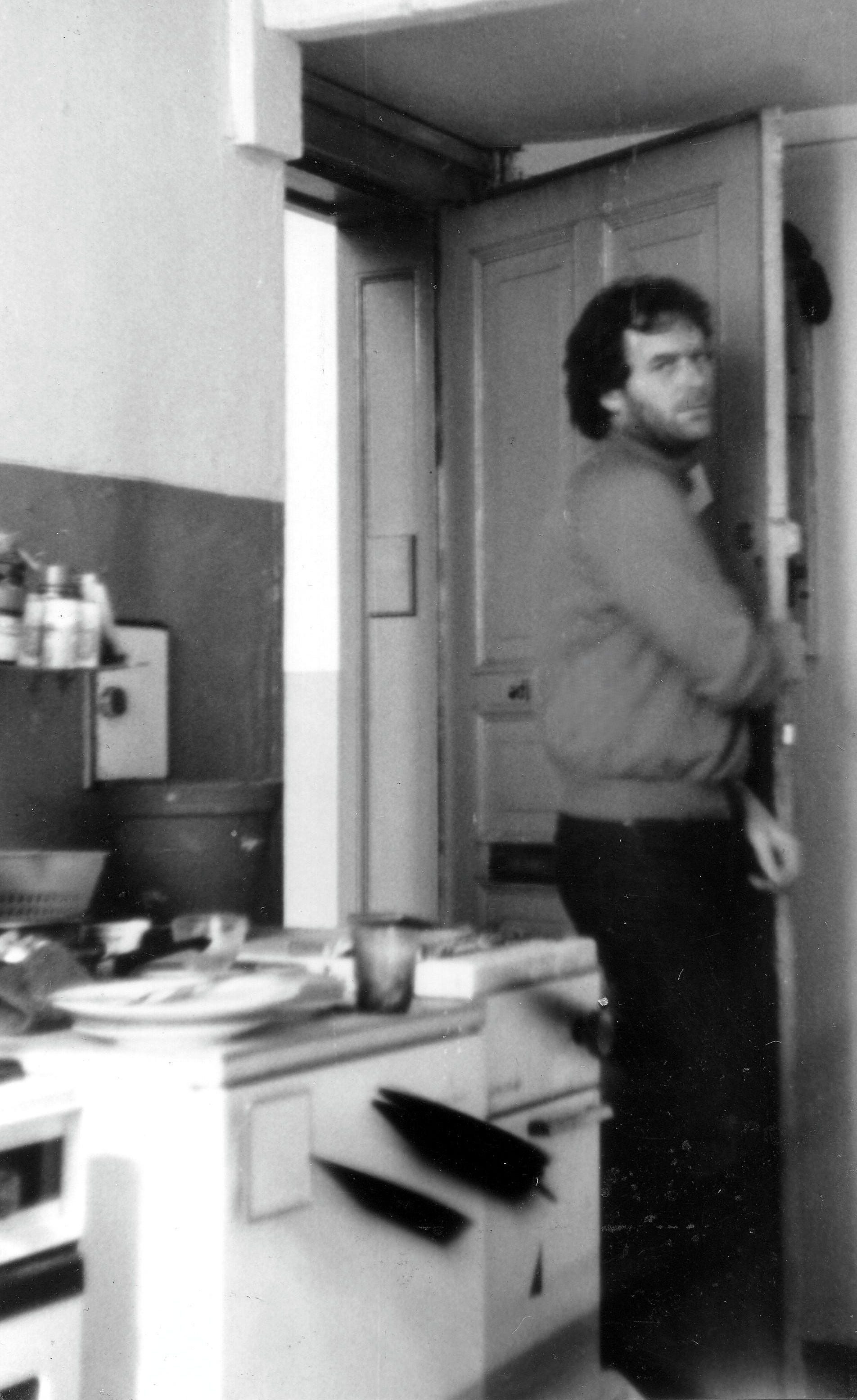
Bryan’s flat in Monumentenstraße 36, in Berlin-Schöneberg, had one room and a kitchen. The toilet was one flight of stairs below and was shared by four flats. We heated the flat using a Kachelofen, a large tile stove with a fire at the base, fueled with lignite or anthracite coal briquettes. On waking up, we would fill up the hearth with 4-6 briketts, light it, close it up, and the fire would slowly heat up the internal masonry that would radiate heat for the rest of the day. It was a cheap and efficient way of heating, but terrible for the environment, accounting for much of Berlin’s smog.
Poland had eased travel restrictions for its citizens, possibly to take the wind out of Solidarnosc sails which was gaining ever more popularity. Polish workers would get onto tourist busses to West Berlin and stay there, working on building sites, for as long as they were able. For most, this was three months, but many overstayed their visa limit and quite a lot emigrated altogether1.
Monumentenstraße housed a great many Polish building workers who would stay, 10 men to a one-roomed flat (about 30 m2), for a few months before a new bunch arrived. There were regular police raids on these flats in the middle of the night, looking for illegal workers. The police didn’t differentiate between us and the Polish, they banged on the door until we opened up and showed our passports and residence permits, sometimes several times a week.
The number of users for the stairway toilets became untenable, so that they regularly blocked and sewage overflowed onto the stairs. It wasn’t long before I made the decision that my love for Bryan did not extend to such living conditions, and I moved to a friend’s place in Riemannstraße in Berlin-Kreuzberg, and started looking seriously for another flat for myself, alone.
West Berlin was named European City of Culture in 1988 (E88), the first German city to be thus titled. After Athens, Florence and Amsterdam, Berlin was to become a giant Werkstatt (workshop) for experimental art, dance, theatre, film, fashion — with a focus on cross-border cooperation, and was showered with money from the federal government. The slogan for E88 was “The World is Invited to Berlin” to witness the fundamental quality of its newness and European Modernism2. As Karl Scheffler said in 1910, Berlin’s destiny is “to always be in a state of becoming and never a state of being.”3 Which in my view explains why Berlin has always been a massive building site that is never finished, even today.
Again, plans to make West Berlin appear shiny and new were scuppered by the politics of the day. Following intense debate and the collection of over half a million signatures petitioning against it, the Conservative government made a decision to lift the Mietpreisbindung (rent controls) in West Berlin from 1 January onwards, and to replace it with a Mietspiegel (rent index). This liberalisation of the system meant that rents went up, ending decades of artificially capping rents in order to keep housing affordable after the Second World War. West Berlin, like Hamburg and Munich before, now belonged to the “White Circle” of cities with free market prices for accommodation4.
The reaction was angry and swift. People began organising resistance and May Day was chosen as the best time to take to the streets. While the tenants’ activist groups wanted a large peaceful demonstration, the autonomous movement had other ideas and once again the day of protest turned into a riot. Only this time, the police were out for revenge for 1987 and violence was much more extreme.
Shortly afterwards, a small patch of wild flower-covered wasteground between Lennéstraße, Bellvuestraße, and Ebertstraße in Berlin-Tiergarten became the centre of a new protest. Lenné-Dreieck (Lenné Triangle) belonged to the GDR but was on the West side of the Wall. On 31 March 1988, an agreement was reached to exchange this patch of land for 16 other pieces of land elsewhere. West Berlin also paid the GDR 76 million DM on top.
However, on 25 May 1988 (the anniversary of the Volkszählung 1987), before the exchange could take place, a large demonstration took place on the land, calling for the Triangle to be occupied. The protesters renamed it “Kubat-Dreieck”, after an activist who had been arrested during the May Day riots the previous year and had taken his life in his cell on 26 May 1987. The protest became a permanent camp over the following months and was a major tourist attraction, but not the kind of attraction the Senator for Culture was hoping for.
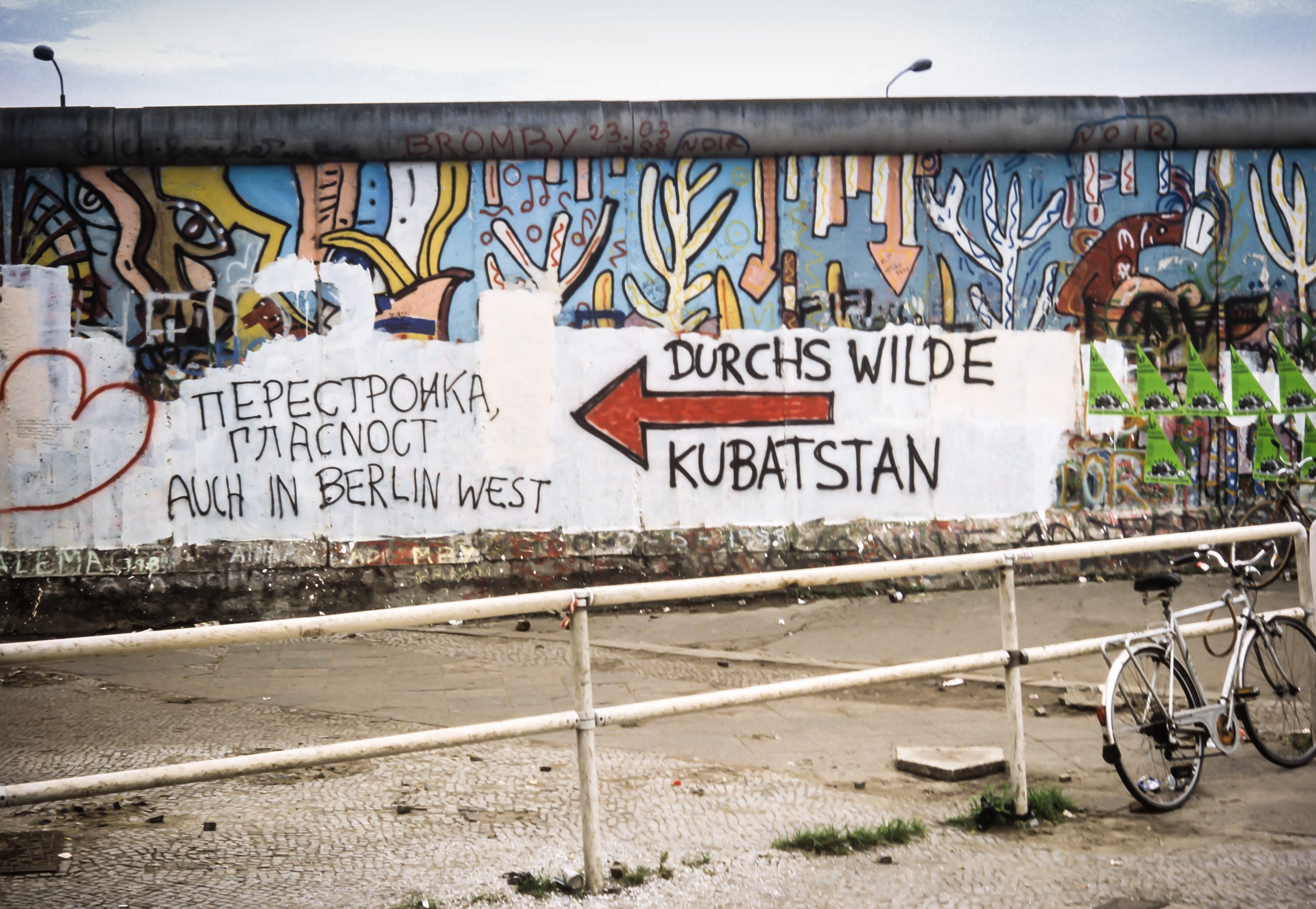
By June 1988, a colourful village of huts, tents, field kitchens, goats, vegetable gardens and street signs had grown up. On 20 June 1988, the West Berlin police fenced the area off and began to clear the area using tear gas and water cannon. The occupiers responded with “mollies” (molotov cocktails), drumming, and tore the fence down again.
1988 was also a year full of dramatic escapes, such as the truck that broke through several barriers on the Glienicker Bridge in March, bringing three young men to the West. Or the cleaner who used his window-cleaning ladder to clamber over the Wall in Treptow in April. The guards shot 18 times, managing to completely miss the escapee5, perhaps deliberately. However, the most interesting escape of all was to go in the other direction: from West to East, and was at Lenné-Dreieck.
On the day of the exchange of land, 1 July 1988, an enormous police action started to clear the area with bulldozers, again fencing it off. The occupiers responded by moving to the small strip at the base of the Wall that belonged to the GDR. Then about 200 people climbed over the Wall. On the East side they were welcomed with open arms and trucks, and given breakfast, before being brought back to West Berlin6.
While the autonomous movement were fighting for Kubatdreieck, a cultural battle of concerts was taking place in the divided Berlin: on Whit weekend, Pink Floyd and Michael Jackson played in front of the Reichstag, attracting once again an audience on the East side of the Wall. Like in 1987, the Volkspolizei tried to break up the gathering and made arrests7.
The GDR had tried, however, to prevent a reoccurence of the events of 1987 by putting on their own concerts on the same weekend. James Brown and Bryan Adams played at the Weissensee bike race track in East Berlin as part of the “Friedenswoche der Berliner Jugend” (Youth Peace Week). Altogether, over 100,000 people came to the weekend’s concerts.
A month later, on 19 July 1988, Bruce Springsteen provided the high point in a summer of concerts with Western bands in the East that had included Joe Cocker and Depeche Mode. Although the FDJ (Freie Deutsche Jugend, free German youth) billed it originally as a solidarity concert for Nicaragua, Springsteen protested, saying that he wanted nothing of the sort. Instead, he encouraged the massive audience to sing “Born in the USA” and was surprised to find that they knew the text by heart.
Later, the concerts in 1988 became known as the “Cold War of Concerts”8 with the GDR trying to keep its disenchanted youth from leaving the FDJ, and away from the Wall where West Berlin provocatively organised top-billing musicians to play. But there was no stopping the new movement in the East. Young people wanted Western music, not just when the state organised concerts to keep them silent. The seeds of the revolution were already growing. But in the West, we were totally blind to them.
Next up: Der Traum ist aus
Back in the Day in Berlin is a a personal perspective series documenting 40 years of living in Berlin. If you want to know what happened in previous episodes, go back to the first one: Life in Colour.
Diehl J: Poland eases restrictions on travel to West, Washington Post, 2 Apr 1988
30 years. Berlin — European Capital of Culture 1988, Tanz im August, 2018.
"Immerfort zu werden and niemals zu sein”, Karl Scheffler, Berlin — ein Stadtschicksal, 1910.
Berliner Mieterverein: Das Ende der Mietpreisbindung — eine Bilanz, 20 Jahre danach, ah, 28 Mar 2008
Umbruch-Bildarchiv: Das Kubat-Dreieck, keine Datumsangabe. Photo gallery.
The Berlin Wall: Pink Floyd at the Reichstag, RBB, 16 Jun 1988
Arte: Kalter Krieg der Konzerte, 9.11.2013, Fernsehbeitrag 52:00 Min.
I’m so pleased you decided to write this post Xanthe. There was so much happening in Berlin that I don’t remember hearing about.
I am glad you are back ... I enjoy reading about what was happening in Berlin back in the day and thinking about how that differed to what was happening in my life at the same time here ... very different of course!