
Exodus
Part 16: Summer of 1989

While I was visiting England in May 1989, elections were taking place in East Germany. I can’t remember even being aware of what was probably the biggest trigger for anger and protest in the GDR. After it was announced that the Sozialistische Einheitspartei Deutschlands (SED) had taken 98.85% of the vote1, people began to take to the streets, first in their hundreds, but the numbers grew with every arrest the Stasi made. The Politburo had lost its credibility, once and for all.
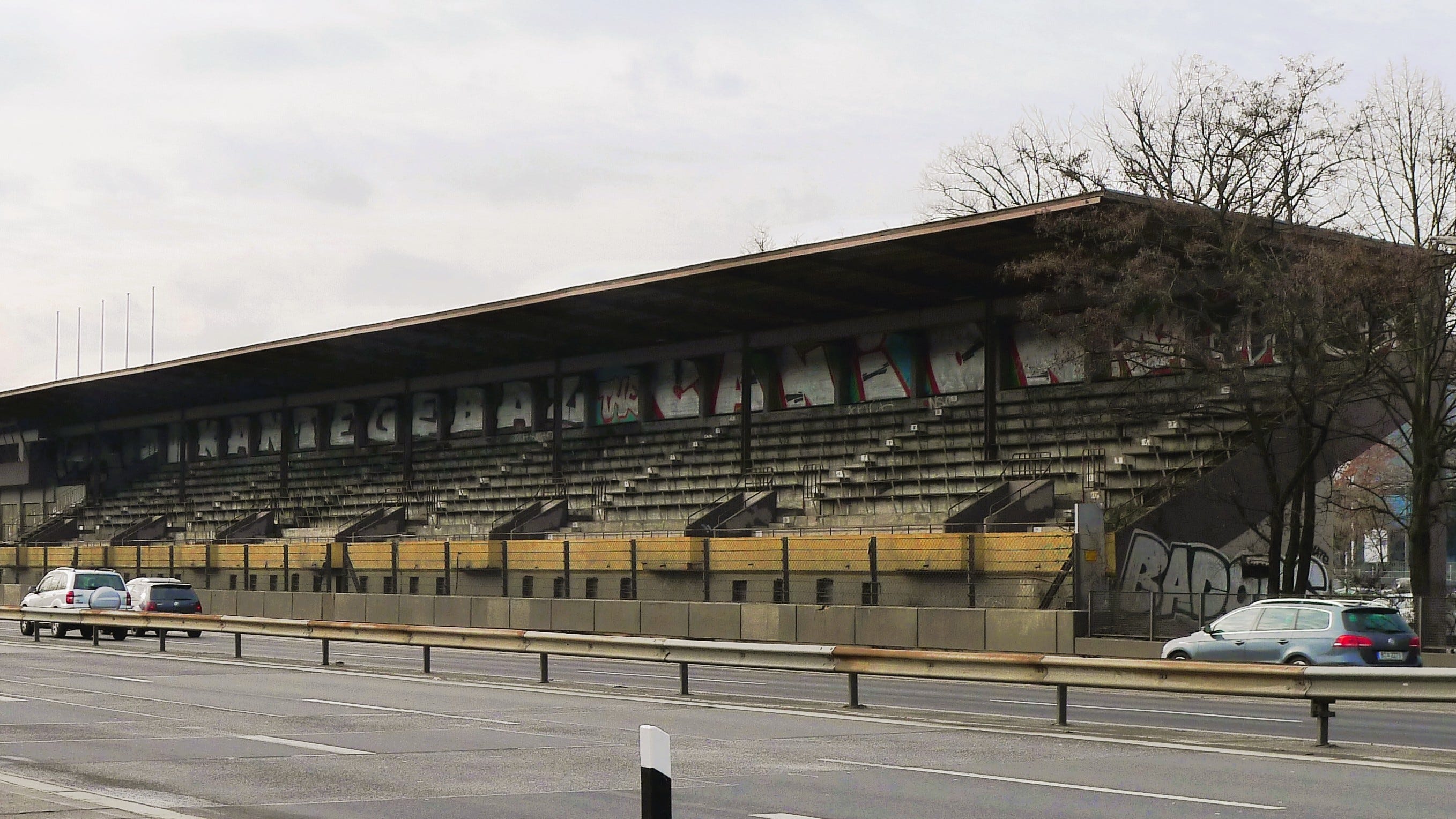
In West Berlin there was also an outcry for freedom: from drivers. The decision to introduce a tempo limit on the AVUS motorway caused an uproar, with a corso demonstration of thousands of cars and motorbikes, on 3 June, organised by the car lobby ADAC. The AVUS was a stretch of motorway that cut through Berlin’s biggest forest: the Grunewald. It was a popular racetrack, both officially and unofficially. At the weekend, motorbike riders gathered at the AVUS Treff on the Spinnerbrücke in their hundreds to race each other down the AVUS.2
Even the feelgood memories of the sold-out concert of the Bee Gees in the Waldbühne on 3 June couldn’t compete with what came next. On 4 June, shock waves went around the world at the reports of the massacre on Tiananmen Square. Hope had been high that the non-violent protest in China could bring reforms, like those in the Soviet Union. Now, people feared that — despite Perestroika — repression could just as easily swiftly follow protest in the Soviet republics, as in China. Although the West had fallen in love with Gorbachev, noone was really sure he could keep power while facing economic collapse. The hardliners could easily overthrow him and reinstitute the old ways.
At the same time, the Communist party in Poland suffered defeat and Solidarnosc steamed ahead towards freeing Poland. Gorbachev visited West Germany and declared that the people could freely choose their own political and social system. He even stated “The Wall can disappear again once the circumstances that gave rise to it no longer exist.”
In Hungary, the governing party began talks with the opposition about holding free elections. Already on 2 May a press conference was held at which a military spokesperson announced that the old border fence that was rusty and in need of repair would not be replaced but taken down. When asked what the GDR had to say about it, he replied “this measure is an internal matter for the Hungarian government.” In other words, the Iron Curtain had been drawn back and was letting light in3.
The new Berlin Mayor, Walter Momper, visited East Berlin and the SED leader, Erich Honecker on 20 June 1989 to discuss easing travel restrictions to East Berlin for West Berliners. The following day, 25 opposition groups criticised the “ignorance” of the GDR leadership for their stance on the Tiananmen massacre and their general rejection of efforts towards democracy.
All the while the citizens of the GDR were packing their bags and looking for a way out. The West German mission in East Berlin was closed on 27 June because of “overcrowding” and the exodus began via the Hungarian border to Austria4.
As usual, West Berlin was more concerned with where to find the next rave. On 1 July, the greatest ever rave was organised by the Schöneberger DJ Dr Motte and multimedia artist Danielle de Picciotto on the Ku’damm: the Love Parade. To escape having to clear up afterwards, the parade was registered with the police as a political demonstration under the motto “Friede, Freude, Eierkuchen”5.
I wasn’t really into techno in those days, so I missed out on the first Love Parade. FOMO6 wasn’t really a thing for me, there was so much on offer that you were always missing out on something. I was consumed with my new task of writing on theatre in The Edge, running around reviewing performances in fringe theatres, and having a great time. And yet, the best was still to come.
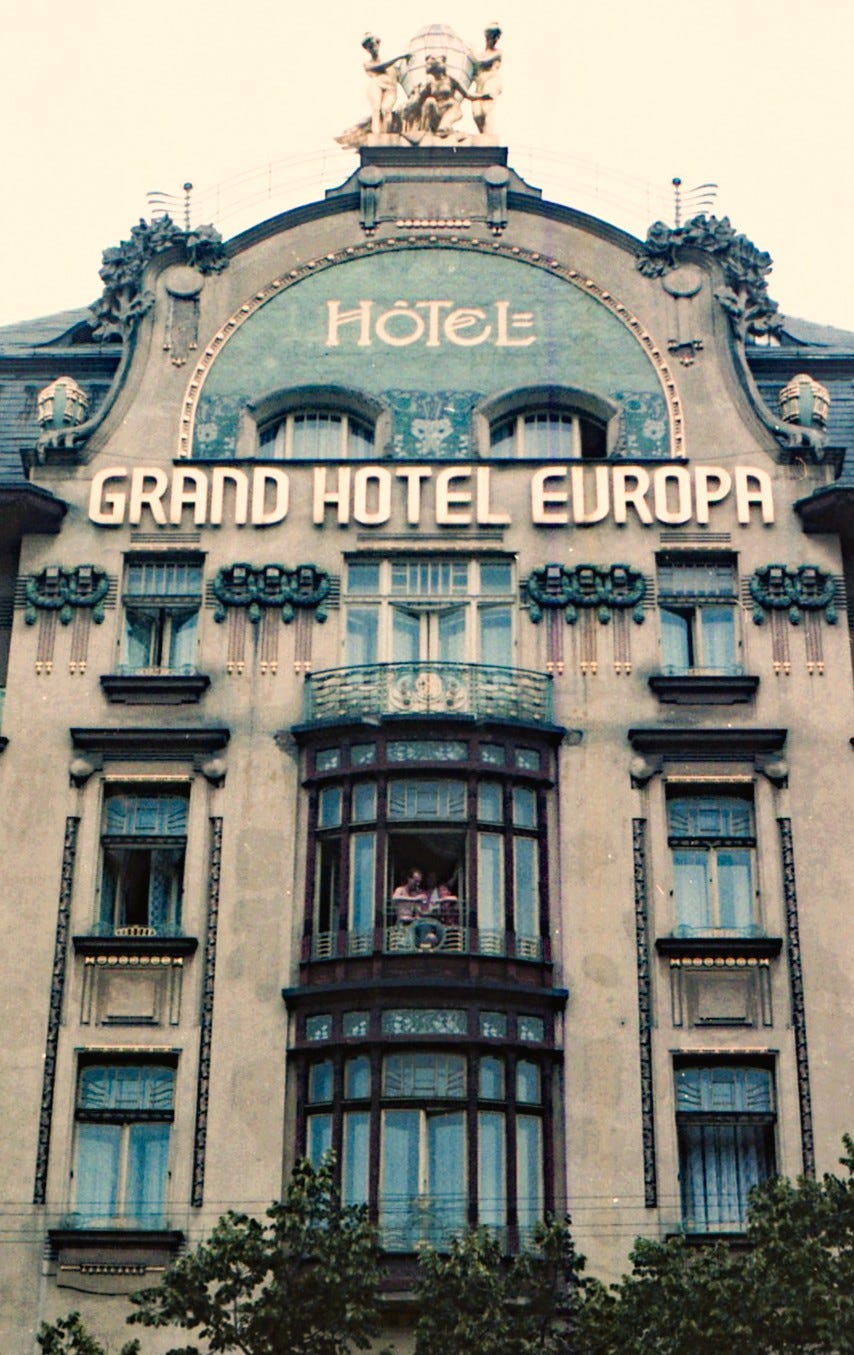
In the second half of July I went to Prague. The country was preparing for the Presidential election in December and the oppostion was gearing up for the Velvet Revolution. There was a feeling of tension in the air, the city felt vibrant. We took an overnight train from Lichtenberg in East Berlin and emerged into the Prague sunlight to a city of such beauty, we spent the first couple of days with our mouths open. Being typically Western, we marched into the most stunning art deco hotel on Wenceslas Square and asked for a room. Apart from one double, they were sold out, but they gave me and my friend P. one of the little staff bedrooms at the back, while our other friends M. and M. got a big room with a balcony looking out on Wenceslas Square.
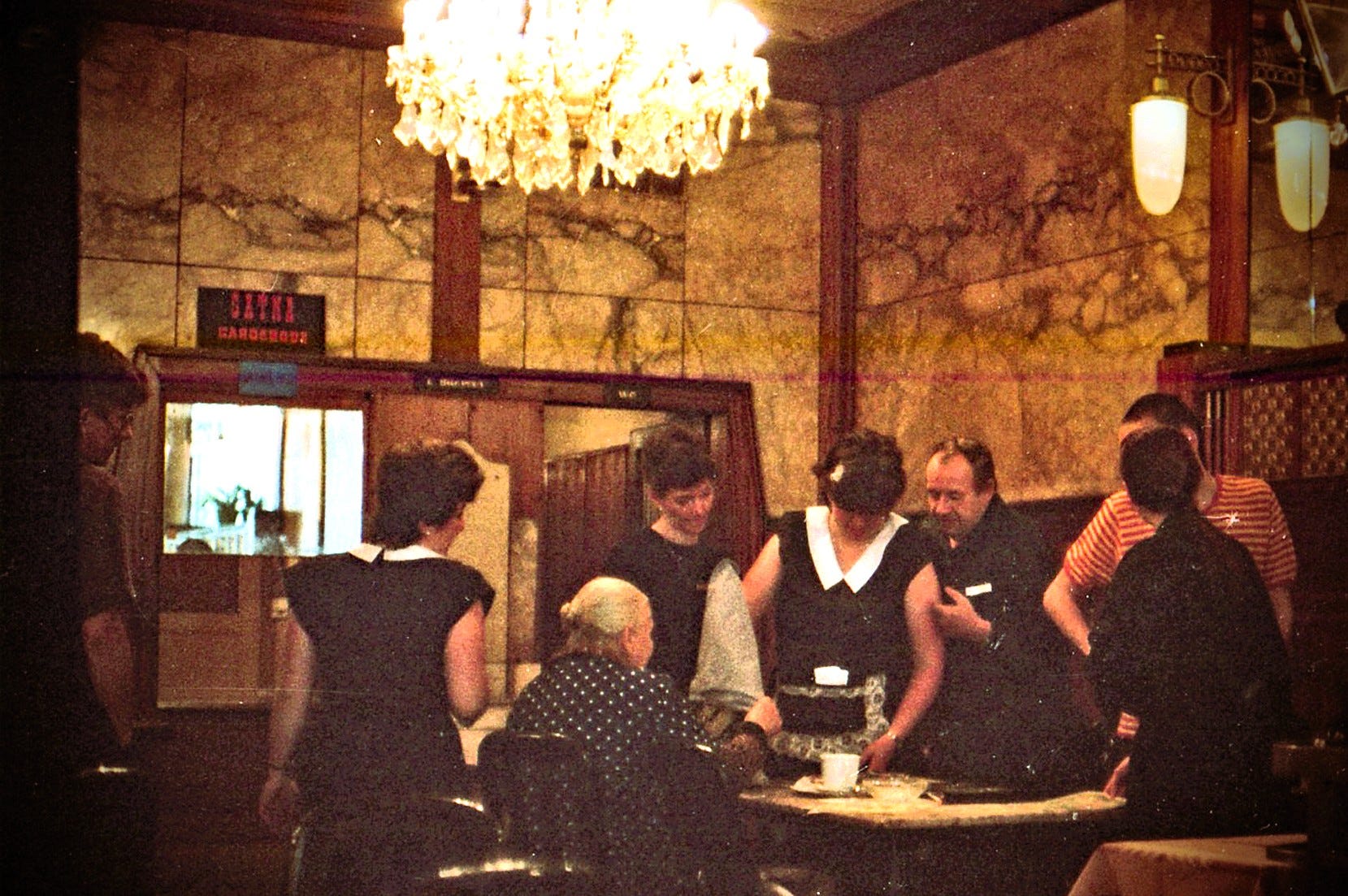
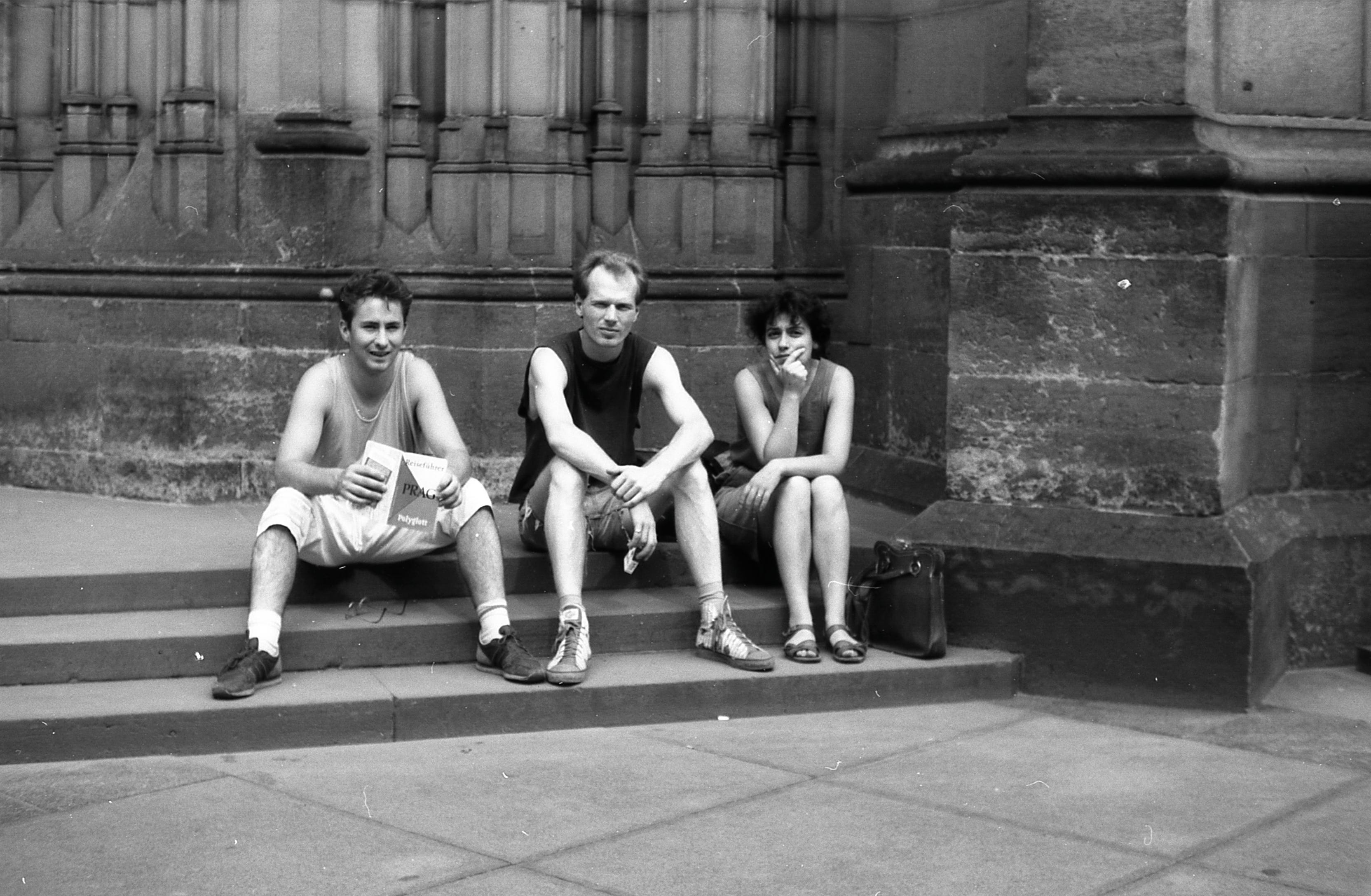
My main memory of that visit, apart from the incredible beauty of the city, was of meeting a couple from East Berlin in a beer bar. The man asked endless questions about the West, while his girlfriend sat next to him, holding his hand and crying. It was only later, when we heard that people were climbing over the wall of the German Embassy in Prague while we were happily supping our beers and seeing the sights, that I understood. He was leaving; she was not7.
Not very long afterwards, on 30 September 1989, we watched spellbound as West German foreign minister, Hans-Dietrich Genscher stood on the balcony of the same embassy in Prague, now full to the brim with East German refugees, and announced that agreement had been reached. The East Germans would be allowed to travel to the West. History was in the making and we had witnessed it, without even knowing that was what it was.
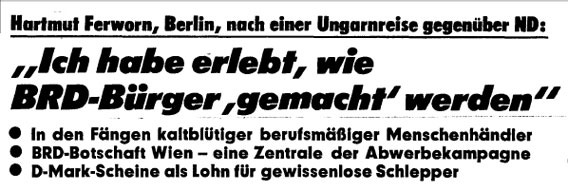
The helplessness of the GDR to keep its people from running away was exhibited most clearly by an article in Neues Deutschland on 21 September 1989. It told the story of Harmut Ferworn, a cook for Mitropa — catering service for the Deutsche Reichsbahn — who was offered a menthol cigarette while staying in Budapest. The cigarette tasted “strange”, as it was allegedly drugged, and the poor man woke up in a West German coach headed for Vienna. In the interview he told of being kidnapped by “cold-blooded human traffickers” with the aim of damaging the reputation of the GDR. This vain pretence that hundreds of thousands of people were being transported out of the country against their will became the biggest joke of the time. At the same time, it demonstrated such a contempt of the Politburo for its citizens, that they could churn out any old propaganda and think it would be believed. It was the final insult, piled upon decades of repression and lies. The exodus was irreversible, the revolution had begun.
Next up: The Fall of the Wall.
Missed the previous posts? Then start here:
Life in colour

I moved to Berlin — or more accurately West Berlin — in May 1985, just over 40 years ago. The date sticks in my mind because of the fallout of my leaving the day before my ex-partner’s birthday. He saw way more significa…
Footnotes (worth reading)
Before the election took place, citizens’ rights activists called for a boycott. Flyers with the slogan “Stell dir vor, es ist Wahl und KEINEr geht hin” (imagine an election and no-one attends) or “Von der Sowjetunion lernen heißt wählen lernen” (learning the Soviet way is learning to vote). But the Stasi (state security) carried out an operation under the motto “Symbol 89” to take over all the voting stations and the counting of the votes, and to make sure that no unwanted candidates got onto the lists. [kurz&knapp: Wahlbetrug 1989 — als die DDR-Regierung ihre Glaubwürdigkeit verlor, Bundeszentrale für politische Bildung, 7 Mai 2019]
The decision for a tempo limit on the AVUS was taken to protect the trees in the Grünewald, but also to improve safety and to reduce noise. However, the official races continued until 1998. The road was built originally as a test track for cars in 1921 and first opened to public traffic in 1940. The Nazi party, with their adoration of cars, were wild for the racetrack, celebrating the wonder of the combustion engine like never before. WW2 put a stop to the races for a while,as the AVUS was badly damaged. After the Wall was built, the AVUS was reduced to only 10 kilometres. The main attraction — the North curve —was closed and yet the symbolic significance for West Berlin of the freedom to drive as fast as you liked for the remaining 6.5 km remained. At the same time, accidents were rife with 108 counted in 1988, in which one death and 14 seriously injured were just too much. The traffic minister announced the tempo limit of 100 and overnight signs were put up, limiting the freedom of the West Berliners who felt waylaid. [Jaedicke T: Die Berliner Avus wird 100, Deutschlandfunk Kultur, 15 Sep 2021]
This hole in the Iron Curtain was the first domino to fall. It set off a chain reaction that resulted in the Fall of the Wall. Imre Pozsgay, sometimes referred to as Hungary’s Gorbachev, said: “Watchtowers, barbed wire and orders to shoot are an anachronism.” [Jauer J: Die Mauer fiel am 2. Mai. Und nicht am 9. November, Bundeszentrale für politische Bildung, 2 May 2024]
On 11 September 1989, the Hungarian and Austrian foreign ministers symbolically cut a hole in the border fence near Sopron. Although the border was still controlled, the stream of GDR refugees was growing exponentially. A chronicle of the events in June 1989 leading to the Fall of the Wall: [“Die Mauer kann weg”, taz, 11 Jun 2009]
Friede(n) — Peace: disarmament on all levels, including between people; Freunde — Joy: through dancing and music as means of communication; Eierkuchen — Pancakes: for a just distribution of food around the world. [Dr Motte zum Loveparade-Jubiläum “Wir wollten diese Beglückung”, taz, 28 Jun 2014]
look it up!
Later, the same guy rang me, who had got out through the embassy and was staying in Munich, asking if he could visit me in Berlin. Worried that he would want to move in, as there were few places for people to stay and many were in camps, I said no and made some excuse. Also, I felt sorry for his girlfriend who he had left behind. Little did he know what would happen within the next four months.