
You Win Again
Part 11: The people are counted

West Germany had been planning on conducting a Volkszählung (census) since 1981. The planned date was 24 April 1983 but just two weeks before the date it was blocked by an injunction. By early 1987, however, the government had overcome all legal obstacles and announced that the census would be taken on 25 May 1987.
But the opposition to the census was massive and on 1 May they peaked with the first Revolutionary 1st May demo, since then an annual occasion where protestors clash with the police. Der Spiegel called it the “The Mother of all riots”1. The so-called Autonomen2 were fed up with the 750th anniversary, angered by the politics of the Conservative government and Berlin Mayor, Eberhard Diepgen, and on top of this, the census, which was viewed as a major breach of privacy rights. On the morning of May 1st, the authorities raided the offices of the census boycott campaign in Kreuzberg, sparking fury.
On the Tag der Arbeit, since 1889 International Workers’ Day, the day that the working classes saw as their own, trade unions and left-wing groups always took to the streets, calling for political change. But this year, the Autonomen had prepared and distributed flyers, calling for people to take to the barricades. “Mollis and Steine für die Bullenschweine” (molotov cocktails and stones for the Pigs) was one motto that incited people to riot.
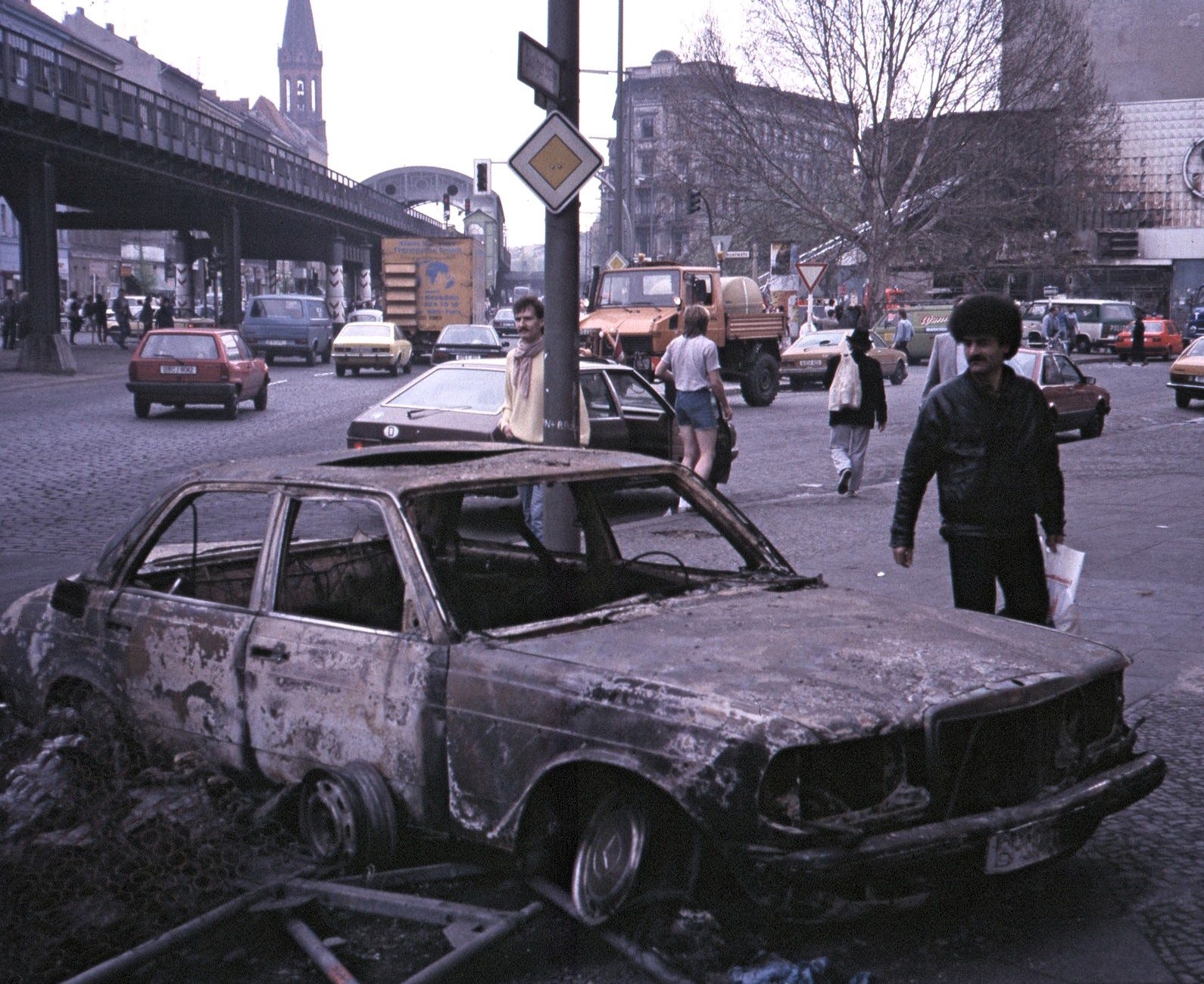
And riot they did. Cobblestones flew, windows were smashed, cars were set alight. Most famously, the Bolle Supermarket on Skalitzer Straße was burnt down. The police responded with batons and teargas.
I remember that I innocently ran into the edge of one of the riots on Heinrich Platz in Kreuzberg, where people were looting a men’s clothing shop, climbing out of the broken shopfront, arms laden with old-fashioned suits and coats. They didn’t seem like Autonomen to me, as they wouldn’t be seen dead in such bourgeois clothing. People began to run down Oranienstraße in the direction of Görlitzer Bahnhof shouting that the Pigs were coming, so I ran too. Luckily, I escaped without harm3.
Somehow, the call to the barricades had enflamed more than just the autonomous movement and spread on that 1987 Mayday to Kreuzberg residents, some of whom had taken the opportunity to help themselves to clothes and groceries from the many shops whose windows were smashed in. The tear gas didn’t help, affecting rioters and residents alike. Anyone who was in the area was liable to be beaten over the head with a police truncheon.
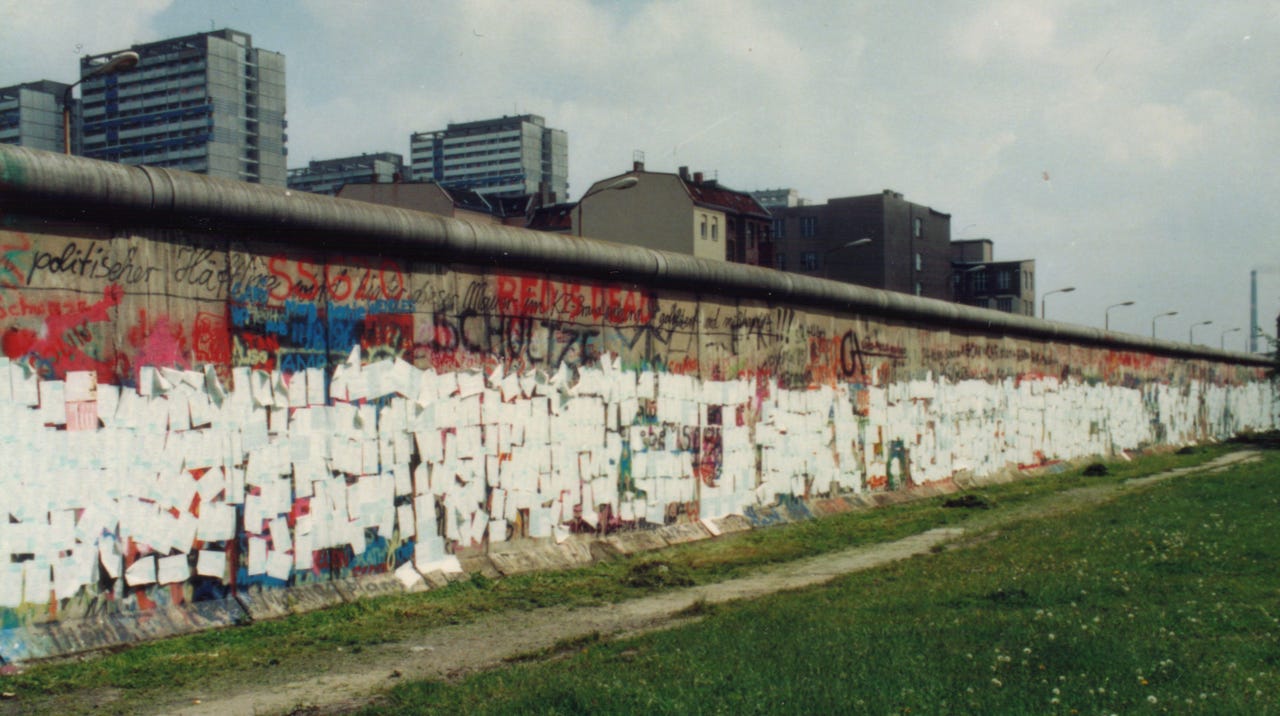
The Volkszählung went ahead all the same, despite the boycott and an unsuccessful constitutional court challenge4. Many protesters stuck their census forms to the Wall under the painted words “lasst Euch nicht erfassen” (don’t let yourself be caught/documented). The fear was widespread that citizens’ rights would be eroded if the government collected so much data on its people. People who didn’t fill in the form were threatened with prosecution, as it was illegal not to participate. After much prevarication and delay, I personally decided to comply, worried that it might otherwise affect my resident’s permit.
Not long after the census, on 28 May, 18 year-old German Mathias Rust landed a Cessna aeroplane on a bridge near Red Square in Moscow. The action was reported on GDR TV briefly on Aktuelle Kamera the day after it happened. The Western media was full of it and I thought it was a really cool action for peace. The shit hit the proverbial fan in the Soviet Union where the head of the air force was sacked and the defence minister suddenly went into retirement5.
As part of the 750th anniversary of Berlin, a Concert for Berlin was to take place in the lawn in front of the Reichstag from 6 to 8 June (Whitsun weekend). I had got a ticket for the full three days and was really wired up, as David Bowie, the Eurythmics and Genesis were headlining. But Bryan was not interested in coming, so I went with other friends.
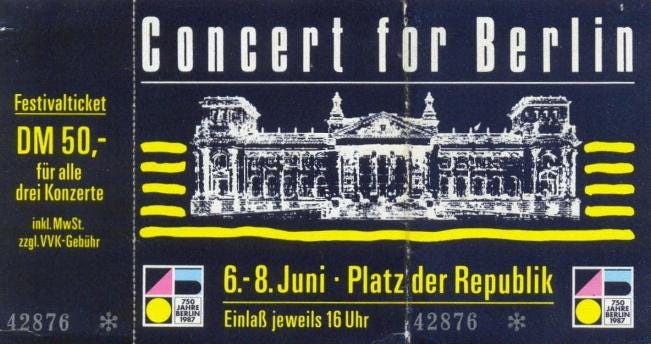
The weather was absolutely perfect and about thousands of people had already gathered on the grass to see New Model Army as support band. But even more had arrived by the time the stage was set up for Bowie’s set, part of The Glass Spider Tour6. Much is made of this concert, as Bowie had agreed — unlike his usual policy — to let the concert be broadcast live by RIAS (Radio in the American Sector), so that fans in the East could also hear him play. He also went over to East Berlin the day before the concert7.
Some say that Bowie’s words, directly spoken in German to his radio audience, were what made many East Berliners go to the Wall behind the Reichstag. Before singing the Berlin anthem “Heroes”, Bowie addressed “those on the other side of the Wall”, sending them best wishes8.
The second day, the stage was set up at the other end of the lawn facing the Reichstag and so Bruce Hornsby & The Range as support and the headlining band Eurythmics could clearly be heard on the other side of the Wall. Even more fans arrived, joined by protestors who had heard that the VoPo or Volkspolizei were trying to break up the gathering.
By the final night with Paul Young and Genesis as the top act, thousands had gathered on the East side to hear the music. It was rumoured that Genesis had turned some of the speakers around especially for them9. But the East German authorities were having none of it and the attempts to repress the East Berliner audience by cordoning off the area sparked a riot. People started to chant Gorbachev’s name, reportedly calling for the Wall to come down. The situation escalated rapidly, truncheons were used, 200 protestors violently arrested10. Altogether, 60,000-70,000 people attended the three-day concert in West Berlin, but several thousand more were present in the East. It is even claimed that it was the cultural catalyst for the fall of the Wall, two years later11.
The concert was a highlight in my early years in Berlin and I often look back with a feeling of pride that I was there, at that moment, when a divided Berlin listened to the same bands. That was the real anniversary event of that year. It was as if people on both sides of the Wall were united in their love of music.
Two days later, on 11 Jun 1987, the British public voted for Margaret Thatcher a third time, making her the longest standing Prime Minister of my departed homeland. Okay, I thought, you win again, and went out to a club to dance to the Bee Gees.
BONUS — for all of you who love the music of the eighties, here is a playlist of my favourite hits from 1987: 1987 Playlist, YouTube Music
Next up: Reagan in Berlin
Wurm P: Ein, zwei — Keilerei! Spiegel Geschichte, 30 Apr 2017
Autonomen are often mistranslated as anarchists, but they were more anti-fascists, clothed in black, that organised as an autonomous movement in the 1980s. They saw themselves as acting autonomously outside of the system of government and the nation-state, looking to build grassroots power from below. Best known as part of the squatters’ movement in Berlin, they were viewed by the authorities as left-wing and dangerous. [Smaligo N: From Autonomen to Antifa, The New Inquiry, 14 Nov 2017]
Take a look at these fantastic photos of 1 Mai 1987 at umbruch-bildarchiv, taken by Peter Homann.
The results of the census in West Berlin showed that about 300,000 residents were missing, leaving just over 2 million. It was claimed by the authorities that only 1% of the population had actually not taken part while the campaign organisers challenged that figure as too low. However, the prosecutions of those who did not fill out the census form were mostly dropped by 1988. [Bundeszentrale für politische Bildung: Vor 30 Jahren: Protest gegen Volkszählung, kurz und knapp, 22 May 2017]
Rust was sentenced to four years in a Soviet prison but was pardoned just over a year later and sent back to Germany. [Hafiz B, Al-Sadoon M: Mathias Rust in Moskau, Deutsches Rundfunkarchiv, no date given]
Here is Bowie’s set list: [setlist.fm: David Bowie’s set list, Platz der Republik, 6 Jun 1987]
Zelle U: 1987: David Bowie Konzert vor dem Reichstag, RBB, 22 Jan 2025
[Hidalgo L: The Concert that Rocked the Berlin Wall, Witness History, BBC, 8 Nov 2019]
That is how I remember it, however there are reports that Bowie also turned the speakers around.
[Sacha: Berlin Whitsun Riots, thewallmuseum.com, 20 Jun 2021]
Bethroars: How Bowie Helped Bring Down The Berlin Wall, 17 May, year not given.
Interesting times. Thanks for linking to the photos (ftnote3).
Those photos are really something, aren't they? I would have liked to have used one of them in the article but didn't have time to ask for permission as I wanted to get this post out for May Day.