
We can be heroes
Part 2: Move to West Berlin

So, that was it: decision made. I have always been quite an impetuous person and once I make up my mind, I simply can’t wait to take action.
Six weeks were all it took to organise and execute my plan of moving to Berlin. It wasn’t difficult, as much of my previous life had reached a natural stop: there was no more funding for my job at Big Brum Theatre-in-Education company1 (another of Thatcher’s victims was public funding for the Arts). My housemates had moved on and I had to decide whether to stay or move on myself. My relationship was over. I wanted something new. I didn’t like England or the way it was headed under Thatcher. And I had always planned on living somewhere else in the World, but I had never dreamt it would be in Germany.
West Berlin was not really Germany, I told myself. It was so cosmopolitan, full of adventure-seekers and misfits from all over the world like myself. The fact that I couldn’t speak any German didn’t seem problematic. I had £600, after buying the flight, and that would have to be enough, until I found a job. I was an economic refugee looking for work in the Playground of the Western World.
I could take 20 kilograms on the plane with me, so everything else had to go. I gave it all away. Only my books were packed in boxes and given to my ex for safekeeping. I gave him the tenancy on the house we had lived in together, and my record collection. And then we organised a big leaving party with a band called “The Cavemen” and 150 guests, squashed into our old house. It was a whirlwind departure and I loved it.
A friend drove me from London to the airport, but we got stuck in traffic. By the time I was at Heathrow, I could no longer check in my 20 kilos (which consisted of clothes, a double duvet, and a ghetto blaster); I had to run to the gate with it on my back for what seemed like miles. Out of breath and feeling slightly naseous, I boarded the plane for the adventure of my life.
I left you at the end of the first post with the revelation that West Berlin was literally walled in. In those days without internet, unless you had a map of Europe and specifically looked at where Berlin was you might have thought it was on the border between East and West Germany and the border ran through the middle. Wrong.
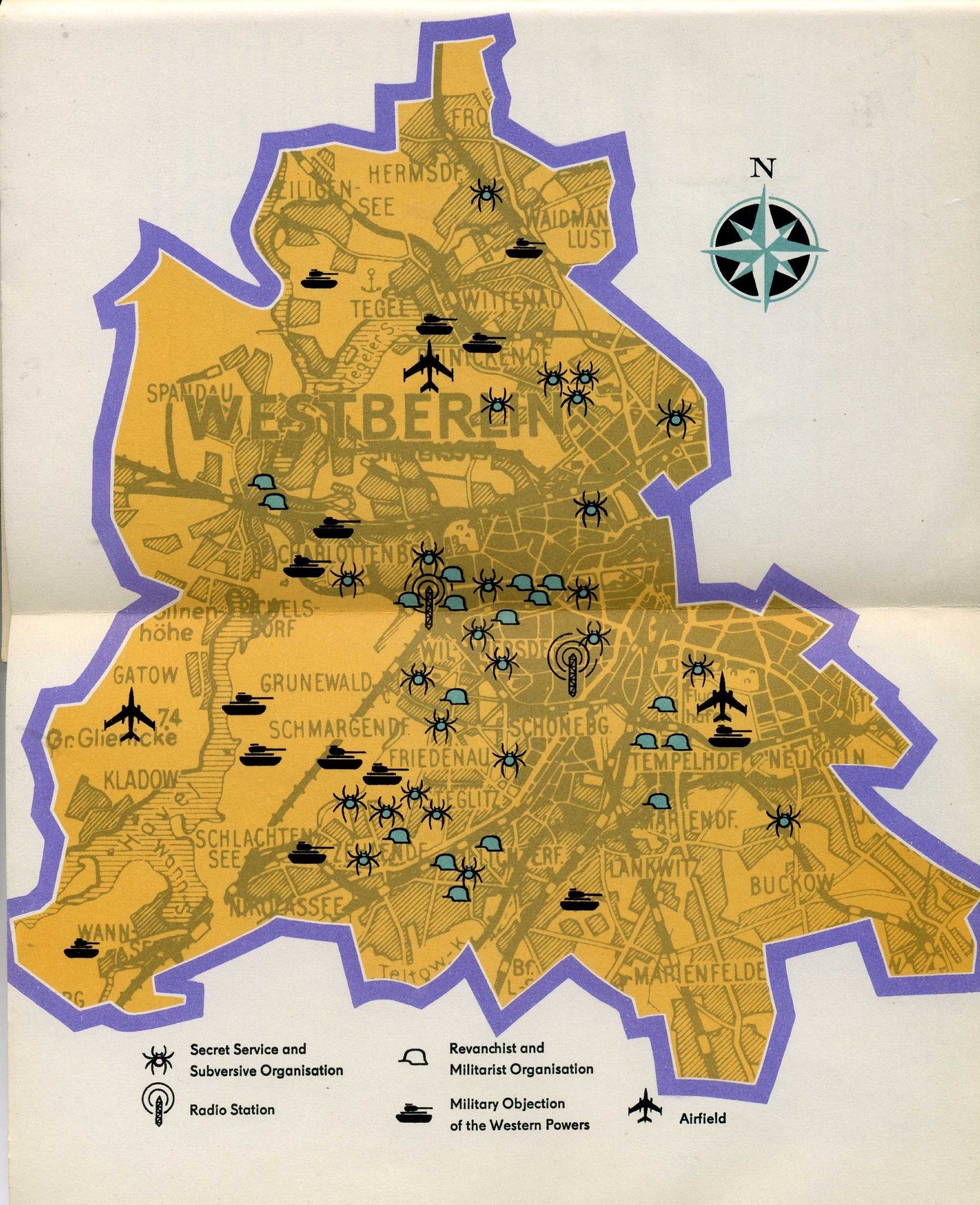
There were three ways to travel to West Berlin: by air, rail or car. But the second two required a long trip through East Germany and crossing two transit points, one at the West German border and one at the border to West Berlin, so the easiest way in was to fly. Ever heard of the Berlin Airlift in 1948-9?2 West Berlin was completely dependent on importing all of its supplies to feed and clothe its residents because it was in the middle of East Germany, an island, surrounded by a wall.
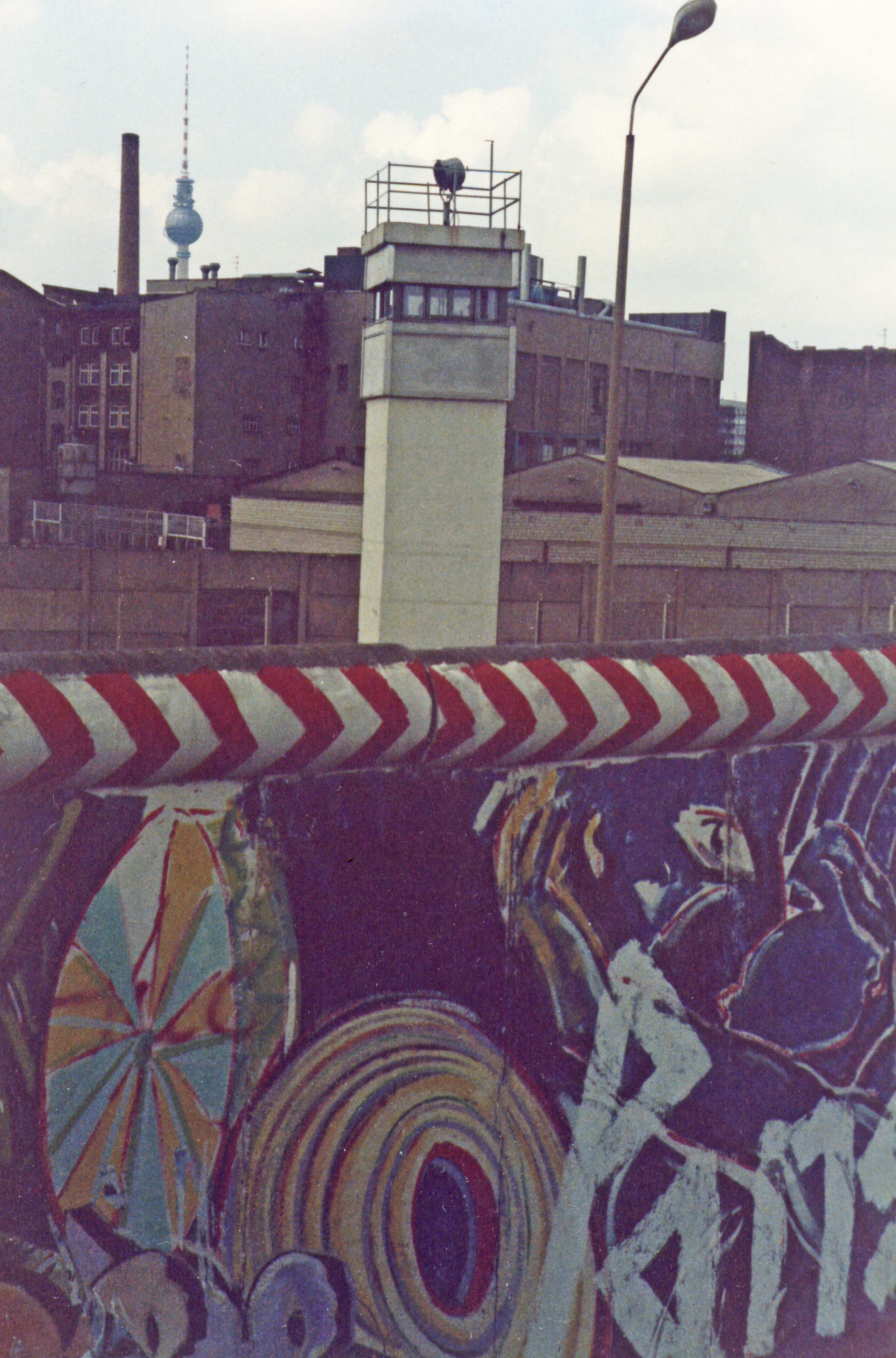
The fact that we were willing prisoners of the Cold War somehow made the whole adventure more exciting. Whichever way you walked, at some point you would bump into the Wall, even if there were fields and lakes in between.
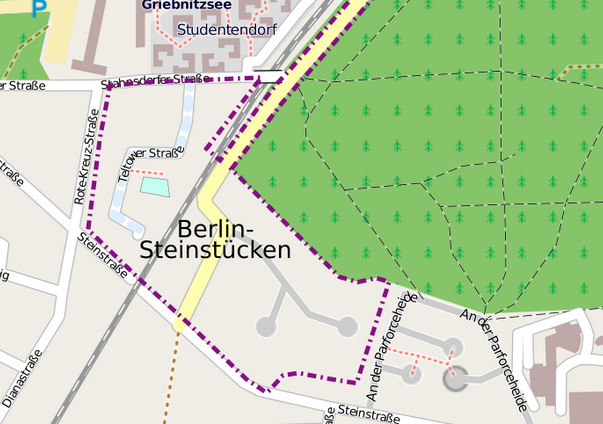
G took me to one place where the Wall made a blip to accommodate an enclave within an enclave: Steinstücken (literally meaning “pieces of stone”). 300 people lived there which was annexed by the GDR, and from 1949 they were cut off by the Wall around them, until in 1972 a road was opened that we used in that day in 1985 to drive into what was intrinsically an enclosed village. Back in the day, though, the inhabitants had to go through two East German border control points on a small road about 1 km long every day to get to work, go shopping, take their kids to school, etc.
Everything in West Berlin was somehow defined by The Wall. Yet, it was easy to forget it was there because life within it was so vibrant and creative. Everyone who was anyone had lived or was living there. In those days I bemoaned the fact that I arrived too late to bump into David Bowie, Lou Reed or Iggy Pop3. Having lived there in 1989, I now no longer complain.
The impressions of that time were breathtaking: Standing by the Wall you literally felt like one of Bowie’s Heroes and imagined the guards shooting above our heads. It was like being part of a famous film, with spies being exchanged on the Glienicke Bridge4, you felt like you were in the middle of history. The walls still showed bullet holes from the combat when the Allies took Berlin, house by house. At the same time, Berlin was a massive art’s centre: Berlin’s Hansa Studios5 in Kreuzberg (Bowie and Iggy’s old haunt) recorded albums in the 1980s by Depeche Mode, Nina Hagen Band, and Siouxie and the Banshees, to name only a few.
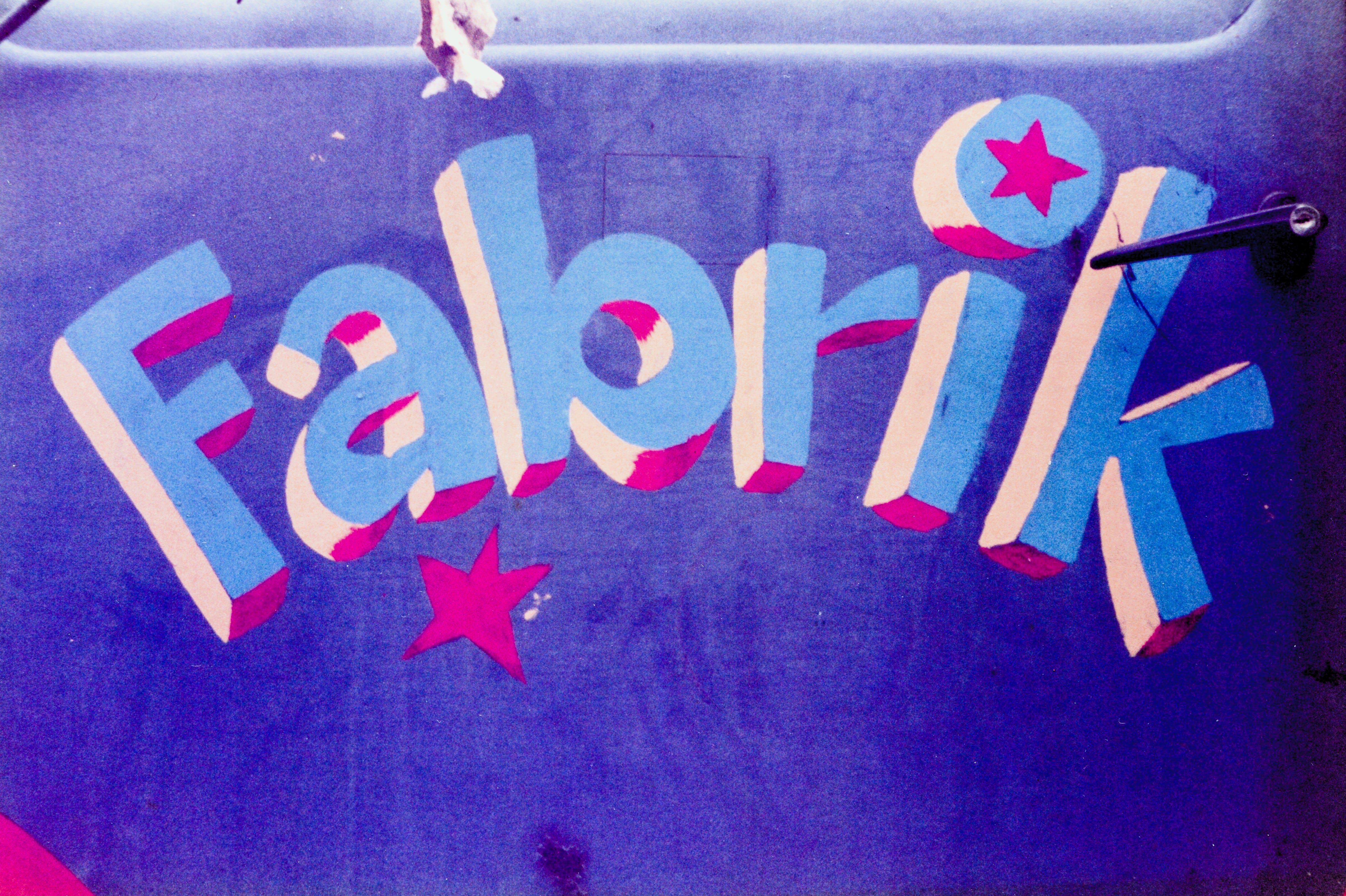
A visit to the ufaFabrik6 in Tempelhof, a cultural oasis established on the site of the old UFA film studios, opened up new forms of communal living and working, even sharing money (till the taxman put a stop to it). The new National Galerie showed Joseph Beuys, famous for his social sculptures and piles of bricks7.
£600 went a long way in 1985, but not far enough. I needed a job. And to get a job in Berlin, you had to speak German. Although I had thought these two things were not problematic in my rush to get to Berlin, the only thing I could say in German was “Haltet die Umwelt sauber” (keep the environment clean) that I had read on a chewing gum wrapper and painstakingly translated with the use of a dictionary. In those days, there were no language-learning apps. You needed money to attend a language school (I hadn’t discovered the wonderful Volkshochschule yet, that would come later). The major language school was the Goethe Institute, out of my financial league.
I was living with a friend (we’ll call her Inge, although that’s not her name) in a leaky flat full of pots to catch the rain on the top floor of a four-storey house in Wedding, in the French Sector. Wedding has nothing to do with getting married and the W is pronounced like a V. Nowadays, it is synonymous with gangster clans, but in those days it was just a working-class area and had little to recommend it. This was home to Schering, the pharmaceutical firm, now taken over by Bayer. I lived on the main street: Müllerstraße. Despite some calling it the “Ku’damm des Nordens”8, the street was dirty and loud, and at one end it was cut off by the Wall.
My attempts at learning German from books, and from my friend when she came home from university, were difficult. The German language is constructed differently, the infinitive being banished to the end of a sentence, so that you had to remember all the time you were saying something that it needed to be correctly finished. No more stream of consciousness or thinking on my feet. Every spoken word needed to be meticulously planned or you would trip up and be left hanging in mid-air with no conclusion.
Then there were the gendered articles: “der”, “die” and “das”. I had learnt French up to A-level at school, so I could cope with male and female, but now I had to get my mind around neuter, like German was already embracing trans (as Berlin really did, being an absolute centre of gender diversity). Apparently, you just had to know the gender of things, there were no real rules or shortcuts. I made the cardinal mistake of learning nouns without learning their genders, which still trips me up today. If you don’t know their gender, then you will get every possible declination wrong, and believe me, there are more declinations than you thought possible. Only one language I have tried to learn beats German for complicated declination, and that’s Greek, which apparently you can learn, but you first need to live there for at least 25 years.
I tried to get by with only using the female article: “die”. It seemed like a feminist way of approaching German. But you’ll find that if you try to be creative with the German language you just end up making everyone into pedants. There is very little tolerance for badly-spoken German. One example was an incident in the Müllerstraße Post Office. Needing a stamp for a letter home, I incorrectly used the informal “Du” form, instead of the formal “Sie", to address the official behind the screen. She refused to sell me a stamp, telling me to go and learn German and come back when I could address her correctly. At least that’s what I think she said, as I fled in tears down the unfriendly street. That was my first experience of the “Berliner Schnauze” (an untranslatable term, something like Berliner “gob” with which they snub you).
Learning German was obviously going to take a little while, I surmised, and I needed money. There was only one real option for girls like me and that was: The Irish Pubs.
Next: Seeking the brightest star
Footnotes (not to be skipped!)
I studied Drama and Theatre Arts at the University of Birmingham and specialised in Theatre-in-Education (TIE). In the final two years of living in Birmingham, I worked, first as a fundraiser and then as an actor-teacher, for the Big Brum TIE company which is still going strong today, despite Thatcher’s attempts to kill the Arts.
After WWII was over and the city was divided, the Soviet Union reacted to the introduction of the new German currency - the Deutschmark - by blockading West Berlin in April 1948. The Western Allies responded by organising an airlift (Berliner Luftbrücke) to bring in supplies to the enclave. Every day from 26 Jun 1948 until 30 Sep 1949 (several months after the blockade was ended), the British and US-American air force flew in tons of food, coal and other necessities to keep West Berlin alive. You can watch the film about the airlift on YouTube here: The Big Lift.
David Bowie and Iggy Pop lived from 1976 to 1978 in Hauptstr. 155 in Berlin-Schöneberg. Bowie recorded “Low”, “Heroes” and “Lodger” at the Hansa Studios in Berlin-Kreuzberg. Iggy Pop recorded “The Idiot” and “Lust for Life”. Lou Reed’s album “Berlin” was actually not inspired by the city which he first visited when Bowie and Pop were living there.
The Glienicke Bridge across the Havel river crossed the border between West Berlin and East Germany during the Cold War and was used to exchange captured spies. It was restricted for use by Allied military and foreign diplomats. In June 1985, 23 US-American agents were swapped for a Polish and three Soviet agents. Spielberg made a film on the bridge, entitled “The Bridge of Spies” (2015).
The Hansa Studios in Berlin-Kreuzberg were originally in the “The Big Hall By The Wall”, 150 metres from the Wall until they moved to Köthener Straße in 1976. David Bowie made the studios famous worldwide, but other famous bands and musicians recorded there including Nick Cave, R.E.M. and Mark Knopfler.
The ufaFabrik is a self-sufficient cultural and living project that hosts a theatre, cinema and circus, as well as being the living space for about 30 people and 180 employees. There was a school, a bakery and a shop, various handicraft workshops, a children’s zoo, and a playground. The site originally housed the film studios Universum Film AG (UFA) which produced propaganda films for the Third Reich during WWII. In 1979 the commune squatted the empty site that was scheduled for demolition. It had been closed since 1956 but belonged to the German Post Office. In 1980 there were violent scenes when the police tried to evict the squatters, resulting in the Berlin government deciding to grant them residence rights for three years. The commune experimented with new ideas for sharing living space, pooling their money and employing residents, until the inland revenue insisted that they needed to pay taxes, and needed them to show individual income, undermining the concept. ufaFabrik is still going strong, read about them here.
Some called Joseph Beuys “7000 Eichen” (7000 oaks), a “social sculpture for Documenta 7 in Kassel, nothing but a “pile of bricks”. The installation was actually made from basalt blocks, each block representing a tree sapling. One by one, over five years, Beuys removed the blocks and planted an oak tree. Beuys died in 1986 but his son and supporters completed the planting of the trees, which was finished in 1987. You can find many of his works in the Marx Collection in Hamburger Bahnhof.
“Ku’damm“ is the abbreviated form of “Kürfürstendamm”, and refers to the main shopping street in West Berlin. Comparison with this wealthy street and its high-end shops and Müllerstraße in the North of Berlin in the 20s and 30s was no longer applicable in 1985 when the street appeared downtrodden and full of shops for the poorer population.
Steinstücken story blows my mind 😳
You're leaving a wonderful Legacy here Xanthe. I loved reading about how you made your way through language difficulties. I know I would be hopeless.